
A canonical mathematical foundations graph — 42 concepts spanning sets through optimal transport — used as the shared substrate for the
study-paperClaude Code skill's per-study learning maps.
| View | URL | Best for |
|---|---|---|
| 🔵 D3 force graph — drag, zoom, filter | pleyva2004.github.io/math-foundations/html/ |
Exploring relationships visually |
| 🗺️ Clickable SVG dependency graph | pleyva2004.github.io/math-foundations/html/graph.svg |
Click any node → jump to that concept |
| 📓 Aggregate Jupyter notebook | notebook/foundations.ipynb |
Cell-by-cell linked index |
Note: the live URLs above are served by GitHub Pages. If they don't work, enable Pages: Settings → Pages → Source: Deploy from a branch → main → /(root) → Save.
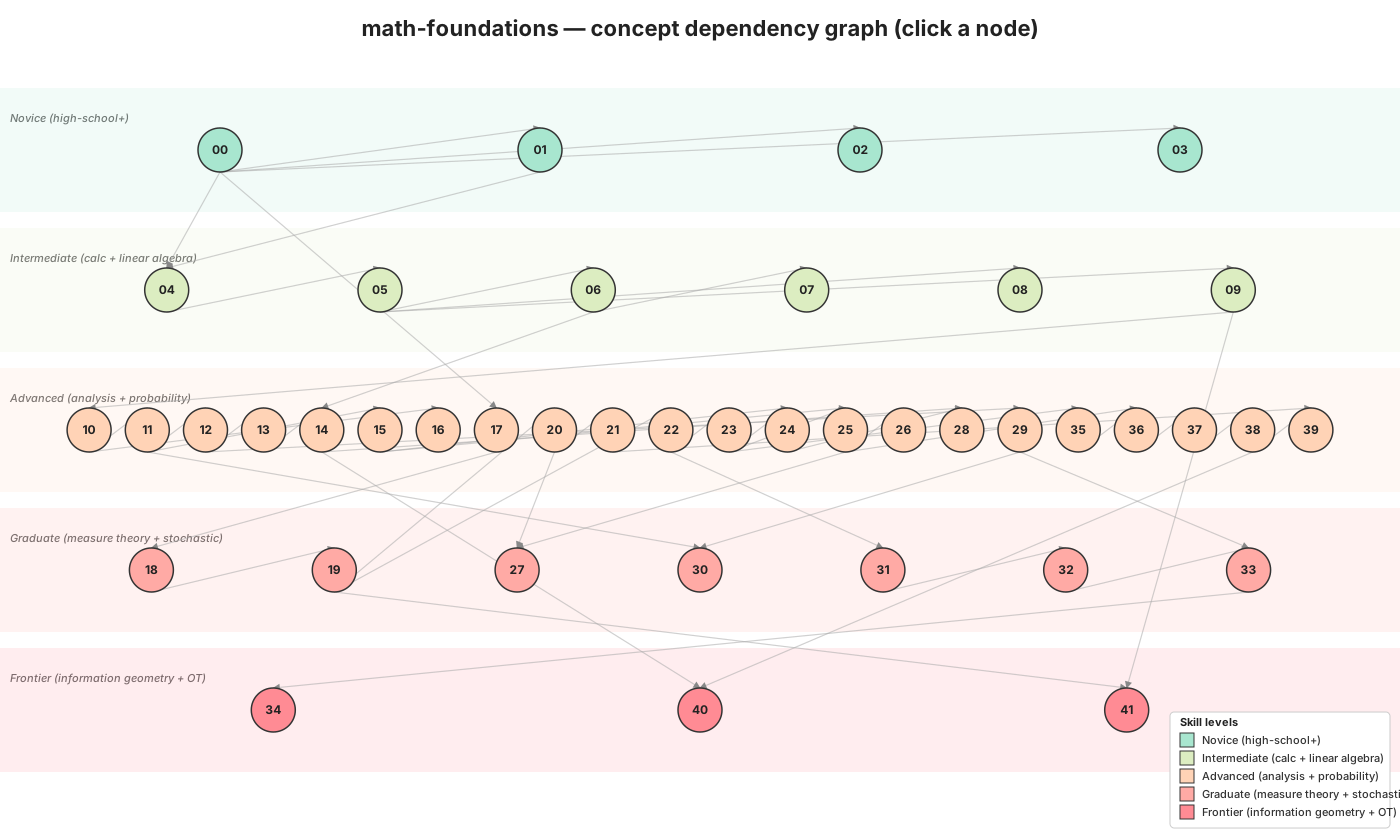
Click the image above → opens the live SVG where each node is a working link to its concept folder.
Every distinct mathematical symbol used across the 42 concept lessons is indexed in a single auto-generated glossary — the canonical "what does this symbol mean and where does it first appear?" lookup:
- 📑 Markdown (browse on GitHub):
NOTATION.md - 📄 PDF cheatsheet (CI-compiled):
notation.pdf— source:notation.tex - 🧩 Single source of truth (machine-readable):
notation.json
Regenerate after editing notation.json:
python generate_notation.pyEvery concept lives in concepts/<NN>-<slug>/:
README.md— plain-English intro + LaTeX math + cross-links.lesson.tex→lesson.pdf(CI-rendered) — standalone formal exposition with theorem + proof.code.py— runnable demonstration (<30 s on CPU; finite/discrete witness for abstract concepts).notebook.ipynb— interactive Jupyter form, runnable in Colab.
| Order | Level | Audience |
|---|---|---|
| 0 | novice |
Novice (high-school+) |
| 1 | intermediate |
Intermediate (calc + linear algebra) |
| 2 | advanced |
Advanced (analysis + probability) |
| 3 | graduate |
Graduate (measure theory + stochastic) |
| 4 | frontier |
Frontier (information geometry + OT) |
| Tour | Audience | File |
|---|---|---|
| Novice | "I don't know what a function is" | tours/novice.md |
| CS undergrad | "I know calc, want probability" | tours/cs-undergrad.md |
| Math grad | "I know measure theory" | tours/math-grad.md |
| Researcher | "Skip to a paper's foundations" | tours/researcher.md |
The full 42-concept list, by level. Every entry below is a working markdown link.
- 00 Sets and Functions — The two foundational objects: collections and rules that map elements between them.
- 01 Logic and Proof — Propositional and predicate logic, truth tables, the basic proof strategies (direct, contrapositive, contradiction, induction).
- 02 Counting and Combinatorics — Counting principles: permutations, combinations, the pigeonhole principle, inclusion-exclusion.
- 03 Relations and Orderings — Equivalence relations, partial and total orders, equivalence classes.
- 04 Groups, Rings, Fields — Abstract algebraic structures with binary operations satisfying axioms.
- 05 Vector Spaces — Sets closed under linear combinations over a field; the universal object of linear algebra.
- 06 Linear Maps and Matrices — Structure-preserving functions between vector spaces; the matrix representation.
- 07 Eigenvalues and Eigenvectors — Directions preserved by a linear map up to scaling; the building blocks of spectral analysis.
- 08 Inner Product Spaces — Vector spaces equipped with a notion of angle and length via an inner product.
- 09 Norms and Metrics — Generalised notions of distance; the foundation of analysis on vector spaces.
- 10 Sequences and Limits — Convergence of sequences; the epsilon-N definition; Cauchy sequences and completeness.
- 11 Continuity — The epsilon-delta definition; continuity as preservation of limits; uniform vs pointwise continuity.
- 12 Derivatives (Univariate) — The local linear approximation; the limit of a difference quotient; differentiation rules.
- 13 Multivariate Calculus — Partial derivatives; the chain rule in multiple variables; directional derivatives.
- 14 Gradient and Jacobian — The gradient as the vector of partial derivatives; the Jacobian as the matrix of partial derivatives of a vector-valued function.
- 15 Integration (Riemann) — The Riemann integral as a limit of step-function approximations; the fundamental theorem of calculus.
- 16 Series and Convergence — Convergence of infinite sums; absolute vs conditional; power series and Taylor expansions.
- 17 Sample Spaces — The set of all possible outcomes of an experiment; the starting point of probability.
- 20 Conditional Probability — P(A | B) = P(A and B) / P(B); the update rule for new information.
- 21 Independence — P(A and B) = P(A) P(B); events that do not influence each other.
- 22 Random Variables — Measurable functions from the sample space to the real line; the bridge from sets-of-outcomes to numerical values.
- 23 Probability Distributions — The full description of a random variable: its cumulative distribution function, its discrete probability mass function, or its continuous probability density function.
- 24 Probability Density Functions — A non-negative integrable function whose integral over a set gives the probability that a continuous random variable lands in that set.
- 25 Expectation — The weighted average of a random variable's values, weighted by their probability; the integral of the random variable against its distribution.
- 26 Variance and Covariance — Second-order moments measuring spread (variance) and linear association (covariance).
- 28 Change of Variables (Probability) — How densities transform under invertible smooth maps; the Jacobian determinant appears as the volume-correction factor.
- 29 Ordinary Differential Equations — Equations relating a function to its derivatives; the basic objects of dynamical systems.
- 35 Self-Information (Surprisal) — I(x) = -log p(x); the surprise associated with observing an outcome under a probability distribution.
- 36 Shannon Entropy — H(X) = E[-log p(X)]; the average information content of a random variable; measures uncertainty.
- 37 Cross-Entropy — H(p, q) = -E_p[log q]; the average code-length when using distribution q to encode samples drawn from p.
- 38 KL Divergence — D_KL(p || q) = E_p[log p - log q]; the relative entropy / information gain in moving from q to p. Non-symmetric, non-metric.
- 39 Mutual Information — I(X; Y) = D_KL(p(x,y) || p(x) p(y)); the reduction in uncertainty about X from observing Y.
- 18 Events and Sigma-Algebras — A sigma-algebra is a collection of subsets closed under complement and countable union; the rigorous basis for which events can be assigned probabilities.
- 19 Probability Measures — A function from a sigma-algebra to [0,1] satisfying countable additivity and P(Omega) = 1.
- 27 Conditional Expectation — The expected value of a random variable given the value of another (or given a sub-sigma-algebra); the foundation of regression and martingale theory.
- 30 Existence and Uniqueness (Picard-Lindelöf) — Sufficient conditions (Lipschitz) under which an ODE has a unique solution; the foundation of well-posed dynamical systems.
- 31 Stochastic Processes — Indexed families of random variables; the time-evolution of randomness.
- 32 Brownian Motion / Wiener Process — The canonical continuous-time stochastic process with independent Gaussian increments; the building block of stochastic calculus.
- 33 Stochastic Differential Equations — Differential equations driven by Brownian motion; the continuous-time analogue of random walks.
- 34 Itô Calculus — The calculus of stochastic integrals where the integrator is non-smooth (Brownian); Itô's lemma replaces the chain rule.
- 40 Information Geometry (Fisher Metric) — Treats probability distributions as points on a Riemannian manifold; the Fisher information matrix as the natural metric tensor.
- 41 Optimal Transport (Wasserstein) — Wasserstein distance W_p(mu, nu) = inf over couplings of E[|X - Y|^p]^(1/p); the cost of optimally moving one distribution to another. Provides a meaningful metric on distributions even when they have disjoint supports.
When the study-paper skill encounters a paper whose math deep dive defines a concept not yet in this graph, Stage 7 of the skill adds it here. This repo is the durable shared substrate.
python generate.py            # refresh README, html/data.json, aggregate notebook
python generate_svg.py        # refresh html/graph.svg
python generate_notation.py   # refresh NOTATION.md and notation.tex from notation.json
python validate_bodies.py # quality-gate the 42 concept foldersMIT.