
An optimal pathfinding challenge in Python & C — with reproducible experiments.




Open the live editor — no installation. Paint walls and weights, move endpoints, then compare Dijkstra and A* on the same map. Includes keyboard controls, pause/reset, a no-route example and a Persian guide.
Watch the 60-second tour · Demo contract and verification
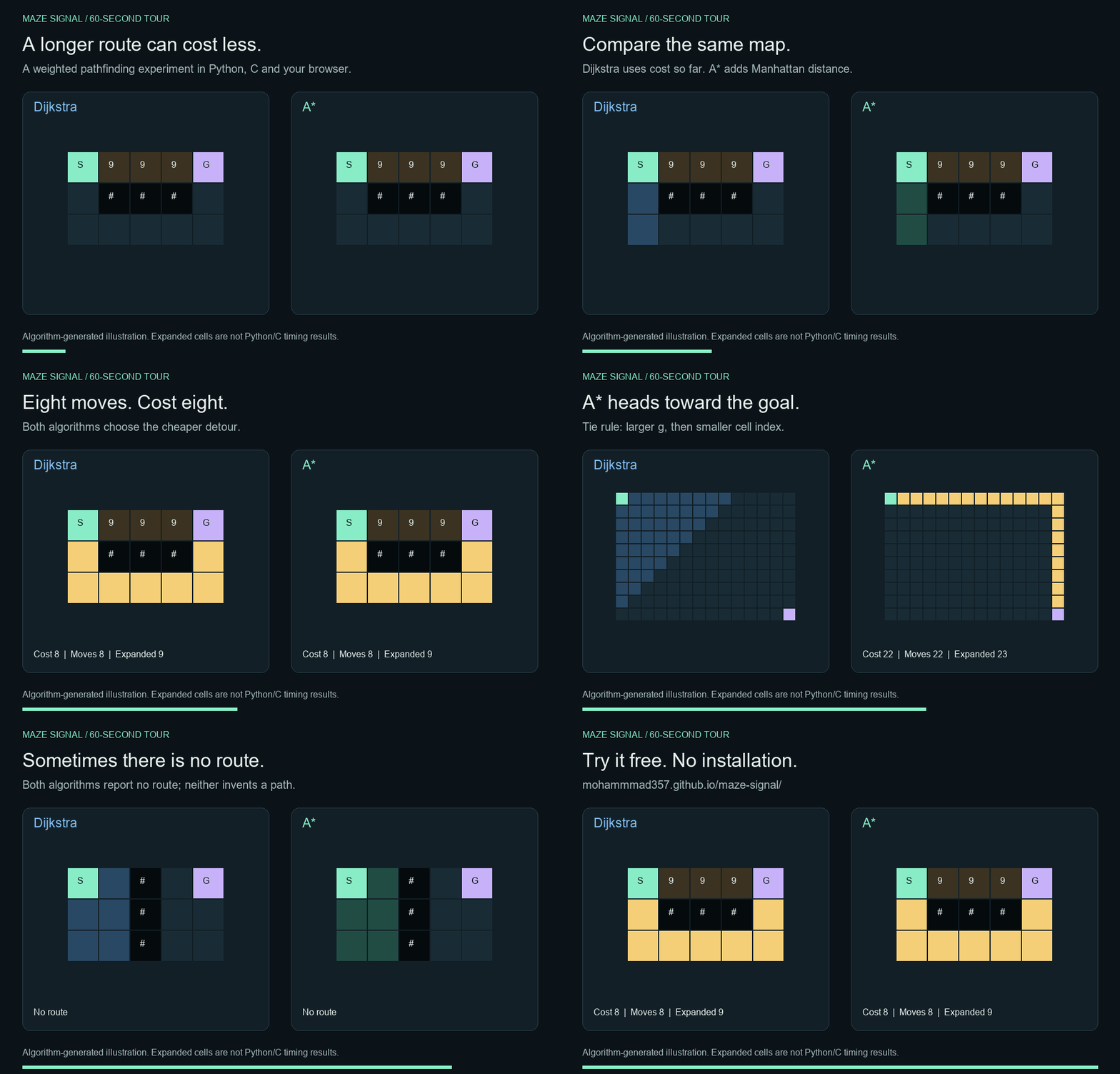
The JavaScript implementation matches 505 fixed/seeded Python/C map fixtures (1010 algorithm comparisons). The browser compares optimal cost and expanded cells; animation speed is not a Python/C benchmark. The tour is an algorithm-generated silent GIF.
Find the minimum-cost route, moving up, down, left or right. Walls block movement; expensive terrain can make a longer route cheaper.
3 5
S999G
.###.
.....
The direct route takes 4 moves and costs 28. The detour takes 8 moves and costs 8. A shortest-by-move-count solution chooses badly here.
Can you find the cheapest route, prove it is optimal, and reduce the amount of the map you explore?
This repository answers with Dijkstra and A*, implemented independently in Python and C11. Both use binary heaps and the same deterministic tie order. No runtime libraries beyond Python's standard library and the C standard library are needed.
Python 3.11+; GCC or a compatible C11 compiler for the native version.
git clone https://github.com/mohammmad357/maze-signal.git
cd maze-signal
python python/solver.py maps/trap.txt astar
Build and run C on Linux/macOS:
mkdir -p build
gcc -std=c11 -O3 -Wall -Wextra -Wpedantic c/solver.c -o build/solver
./build/solver maps/trap.txt astar
python -m unittest discover -s tests -v
Windows PowerShell:
New-Item -ItemType Directory -Force build | Out-Null
gcc -std=c11 -O3 -Wall -Wextra -Wpedantic c/solver.c -o build/solver.exe
./build/solver.exe maps/trap.txt astar
python -m unittest discover -s tests -v
The JSON output reports cost, expanded, path and seconds. Path entries are zero-based row-major cell indices: row = index // width, column = index % width. Unreachable goals produce cost: null and an empty path, with successful exit status. Invalid input produces a nonzero exit status.
First line: height width, each in 1..1024. Then exactly height rows of width cells. LF and CRLF are supported.
| Cell | Meaning | Cost to enter |
|---|---|---|
S |
One start | 1, if entered later |
G |
One goal | 1 |
. |
Ordinary terrain | 1 |
1..9 |
Weighted terrain | Digit value |
# |
Wall | Impassable |
Exactly one S and one G are required. The starting cell has initial cost zero. Diagonals, zero/negative weights, multiple endpoints and blank grid rows are unsupported. S and G occupy distinct cells.
Dijkstra prioritizes the cost so far, g. A* prioritizes f = g + h, where h is Manhattan distance to the goal. Every move costs at least one, so this heuristic never overestimates. It is also consistent: moving one step changes Manhattan distance by at most one, no more than that move's cost. A popped, non-stale goal therefore has optimal cost, and closed nodes need no reopening.
Both versions discard stale heap entries. Ties favor larger g, then smaller cell index. This choice strongly helps A* on open grids and is explicitly part of the experiment. Different tie policies can give different search footprints and equally optimal paths.
On a four-neighbor grid, E = O(V). Worst-case time is O(V log V) and memory O(V), including lazy duplicate heap entries. Positive costs prevent parent cycles. Integer distances in C fit within the configured size limit: even a simple path of 1,048,576 cells at cost 9 stays well below INT_MAX.
Three seeded workloads: an open grid, alternating wall barriers, and random weighted terrain. The weighted map generator opens blocked cells along a boundary route so the goal is reachable; the barriers are deterministic. The hero image is the 31 × 31 open demo, not a screenshot of the larger benchmark.
python tools/experiment.py --binary build/solver --size 160 --repeat 30 --samples 5On Windows, use --binary build/solver.exe.
The script rebuilds maps, the hero SVG, raw timing samples, environment metadata and the results report. Measurements exclude map parsing, executable startup and JSON printing. Search allocations remain included; the Python solver also collects visitation order for rendering.
Read the numbers in context: A* benefits from an informative heuristic. Walls and expensive terrain can weaken that advantage. Benchmarks here illustrate those effects; they do not establish universal speedups between languages or algorithms.
On the committed 160 × 160 open grid, A* expands 319 cells while Dijkstra expands 25,600, an 80.25× reduction, at the same optimal cost of 318. On the barrier map, the reduction is only about 1.8%. Fewer expansions can still take more time because of heuristic and heap overhead; consult the full timing table for both languages.
C timing batches adapt toward 200 ms to reduce clock quantization; every batch's actual repeat count is stored in the raw CSV.
The suite compares 500 seeded random maps and five fixed cases against an independent Bellman-Ford reference. For each map it verifies both languages and both algorithms, path adjacency, path cost, endpoint validity and deterministic expansion counts. Additional malformed-input checks cover invalid dimensions, cells, endpoints and extra data.
GitHub Actions builds C with warnings treated as errors, runs the suite on Python 3.11 and 3.13, then repeats with address and undefined-behavior sanitizers on Linux. Local validation and remote CI status are separate; the badge reflects the latest remote run.
- Add a bidirectional search and measure where it wins.
- Compare tie policies on the same fixed maps.
- Add diagonal moves and derive an admissible heuristic for their costs.
- Implement an indexed heap and measure memory as well as runtime.
- Create adversarial maps where Manhattan distance gives almost no help.
python/solver.py       Readable standard-library implementation
c/solver.c            C11 implementation with a growable binary heap
tests/test_solver.py  Independent reference and differential checks
tools/experiment.py   Deterministic maps, timings and SVG rendering
maps/                 Small examples and committed benchmark inputs
assets/search.svg     Algorithm-generated hero visual
results/              Report, raw samples and environment metadata
Red Blob Games: Introduction to A* is an excellent visual explanation of weighted graph search and heuristics. The implementations, tests and assets here are original to this project; no external code or artwork is bundled.
MIT licensed. Contributions that include correctness evidence and reproducible measurements are welcome.
Try the quick start, report a reproducible issue, or pick a small documentation improvement. See CONTRIBUTING.md for reporting details, development checks and evidence expected for changes.