

Experimental software; not ready for general use.
Leaf is generative UI for Claude Code and Codex. Review a plan, make a decision, or follow live work in a page you can comment on and change. The agent responds by revising the page.

Watch the comment-and-revision loop
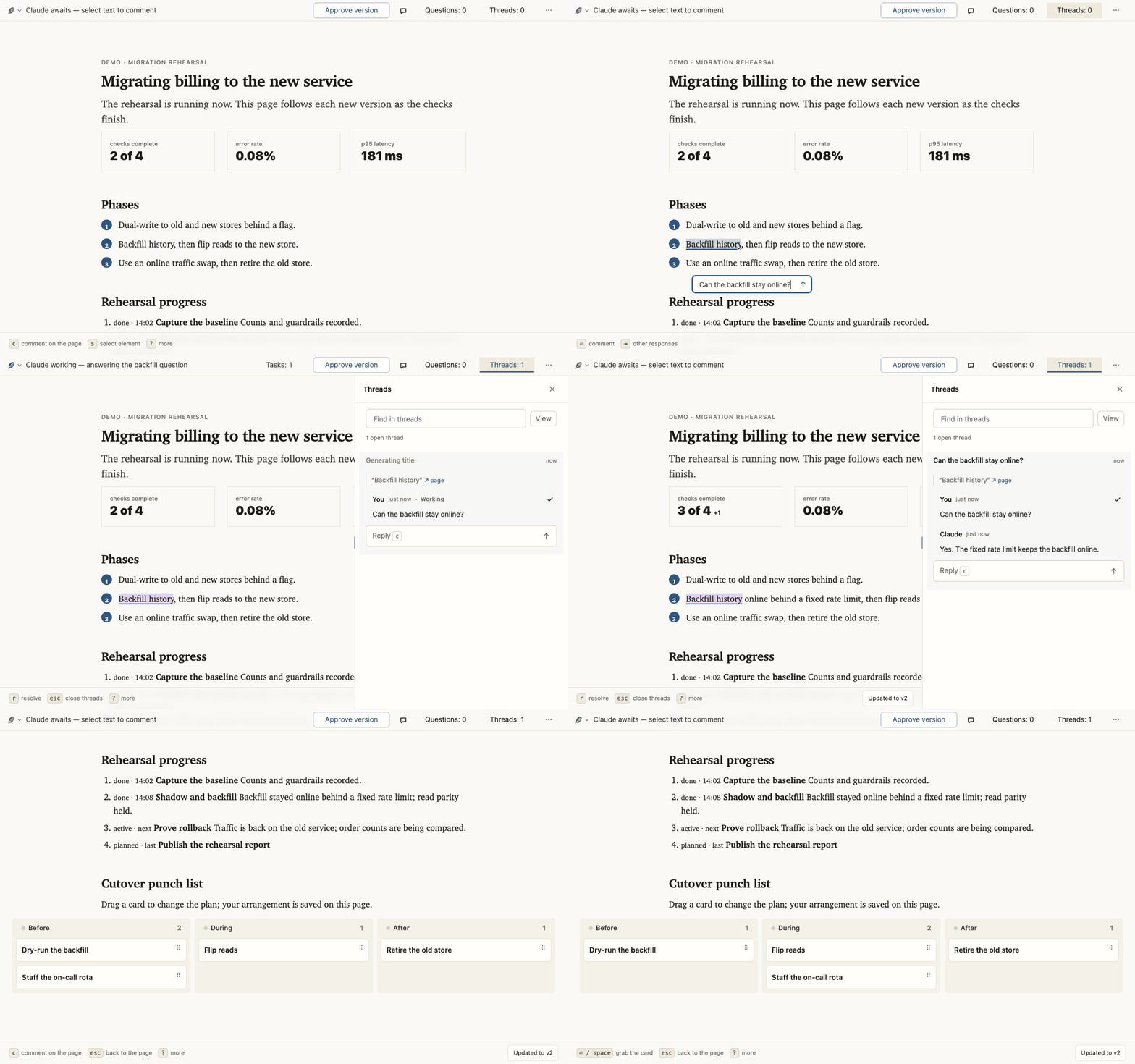
Try Leaf on the home page, where a small demo agent responds in your private copy, or explore the examples.
You need uv,
jq 1.6 or newer on PATH, and a
browser that can reach the machine the agent runs on. No Leaf account or
configuration is required.
Users and package authors never need to build Leaf or run a package manager;
custom widgets are ordinary browser JavaScript.
Install the Leaf plugin, which includes the application, harness integration and the Leaf skill. The skill supplies the agent's instructions; copying its directory alone does not install the application.
Claude Code:
/plugin marketplace add max-sixty/leaf
/plugin install leaf@leaf
Codex:
codex plugin marketplace add max-sixty/leaf
codex plugin add leaf@leaf
Pi (a highly experimental trial, which the rest of these docs don't cover yet):
pi install git:github.com/max-sixty/leaf
Then ask: “Use Leaf to write up the options for this change.” The explicit skill is
/leaf [topic] in Claude Code, $leaf [topic] in Codex, and
/skill:leaf [topic] in Pi; without a topic, it
presents the work already under discussion.
The result opens in a browser page; its comments return to the same agent task.
Browser and environment requirements
Known functional limitations and accepted visual differences in current browsers are recorded in Browser support gaps.
The first run syncs the plugin's uv environment through your configured package
index. Render checks use the executable named by
LEAF_BROWSER_EXECUTABLE, CHROME_PATH, or CHROME_BIN, then installed Google
Chrome, then the first google-chrome, google-chrome-stable, chrome,
chromium, or chromium-browser on PATH.
Leaf needs Claude Code 2.1.196 or later, the first release whose hooks name the turn they run in. On an earlier one, an update handed into a prompt you interrupt waits until that turn ends before it is offered again.
In Claude Code, a background Stop hook watches the session's pages between turns. Leaf's hooks module shows a line above the prompt for each page the session owns, with a link, items waiting on you, the number of open threads and how many contain unread replies, and the agent's activity or waiting status. Ctrl+X Tab then Enter opens the first page in your browser, or, in a session you reached over SSH, copies its link to your clipboard. Hooks modules are an early-access Claude Code feature.
A page messages its session when input arrives while nothing watches it, as can
happen after you interrupt a turn. A session that bypasses permissions holds that
message for your approval unless Claude Code's crossSessionInbound setting is
"accept".
Agent sandboxes
Leaf's hooks run outside an agent's sandbox, but leaf commands run wherever the
agent's shell commands do. The sandbox can block access to resources Leaf needs:
writes to its state in ~/.local/state/leaf, a port on localhost for the page server, and
a browser for render checks.
In Claude Code, Leaf's hook starts a bridge outside the sandbox before the first
leaf command, and each sandboxed leaf command hands itself to the bridge
through the sandbox's network proxy. The first time in a session, Claude Code asks
whether to allow that connection. To allow it without asking, add 127.0.0.1 to Claude Code's settings,
such as ~/.claude/settings.json:
{ "sandbox": { "network": { "allowedDomains": ["127.0.0.1"] } } }Allowing 127.0.0.1 lets every sandboxed command reach any server listening on
this machine's loopback, Leaf's bridge among them, and through the bridge run
leaf commands with your own access, as Leaf's hooks already run.
Codex's sandbox gives a command no such route, so Leaf's Codex plugin adds an MCP
server, leaf, which Codex starts outside the sandbox. In the sandbox the agent runs
leaf commands with the server's run tool. The first time, Codex asks whether to
allow the tool, for the session or always. Allowing it lets the agent run any leaf
command with your own access, including a package's scripts, with arguments it
chooses. To allow it without being asked, add this to ~/.codex/config.toml:
[plugins."leaf@leaf".mcp_servers.leaf]
default_tools_approval_mode = "approve"
The agent's own edits to a page's files still run in Codex's sandbox, which lets
them write only the task's directory and the temporary directories. So Codex
refuses each edit to a page in Leaf's state home, or asks you to approve it. To let
the agent edit pages there, add the state home's pages directory to the sandbox's
writable roots in ~/.codex/config.toml, inside the [sandbox_workspace_write]
table if you already have one:
[sandbox_workspace_write]
writable_roots = ["~/.local/state/leaf/pages"]
If you set XDG_STATE_HOME, the directory is $XDG_STATE_HOME/leaf/pages. Every
command the sandbox runs can then write every page's files, as it can the task's
directory. Where a task's sandbox lacks the line, the MCP server's first answer in
that task gives it to the agent to pass on.
- How it works: comments, decisions, live revisions, and the widgets a page can use.
- Examples: proposals, editable drafts, release workspaces, and code reviews.
- Extending: choose between page-local changes, reusable packages, and Leaf's shared kernel. Your agent can build a widget a task needs and use it in later pages.
- Public contracts: authoring, serving, and continuing a Leaf page.