
Oasis is a libre, open-source, encrypted, peer-to-peer, distributed (not decentralized!) & federated... project networking application that helps you follow interesting content and discover new ones.
Oasis redefines what it means to be connected in the modern world, giving its inhabitants the ability to control their online presence and interactions without the need for centralized institutions.
Main features of the Oasis interface are:
- Data manipulation is not permitted due to the use of BLOCKCHAIN technology.
- No browser JavaScript. Just pure HTML+CSS. A really secure frontend!.
- Use your favorite web browser to read and write messages to the inhabitants you care about.
- Strong cryptography in every single point of the network.
- You are the center of your own distributed network. Online or offline, it works anywhere that you are.
- Initial identities are randomnly generated (no username or password required).
- No personal profile generated (no questions about gender, age, location, etc …).
- Automatic exif stripping (such as GPS coordinates) on images for better privacy.
- No email or associated mobile phone required.
- Automatic updates with new functionalities.
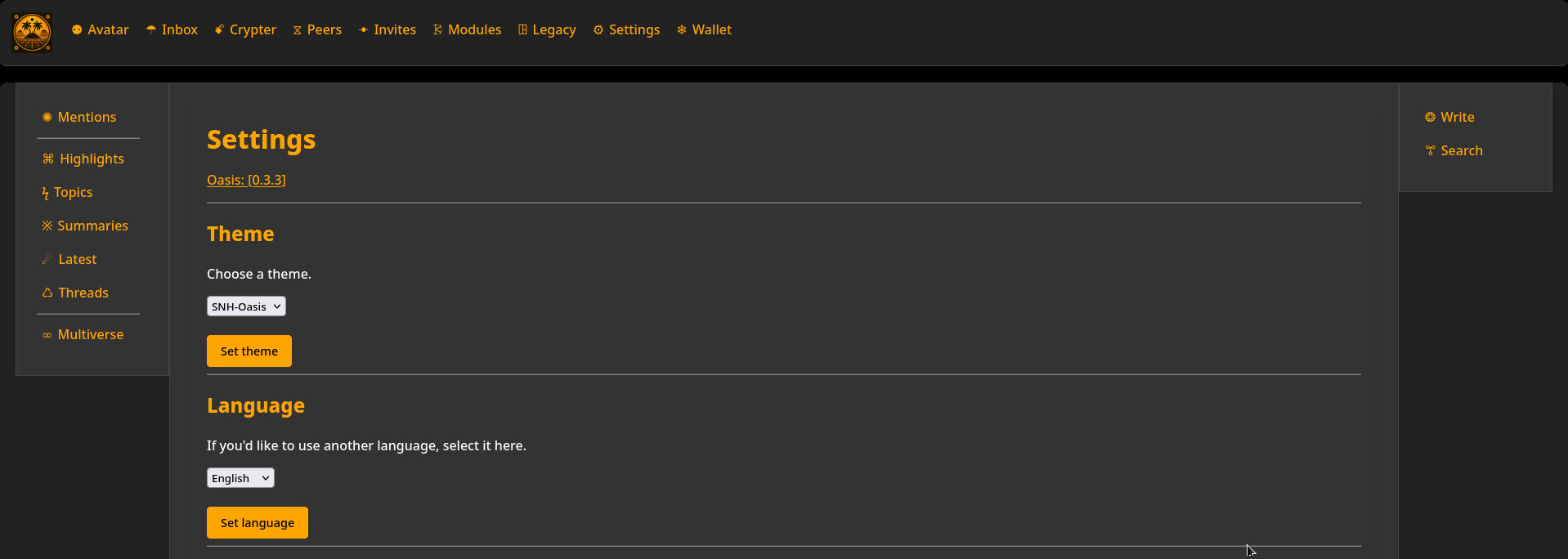
But it has others features that are also really interesting, for example:
- Support for multiple languages.
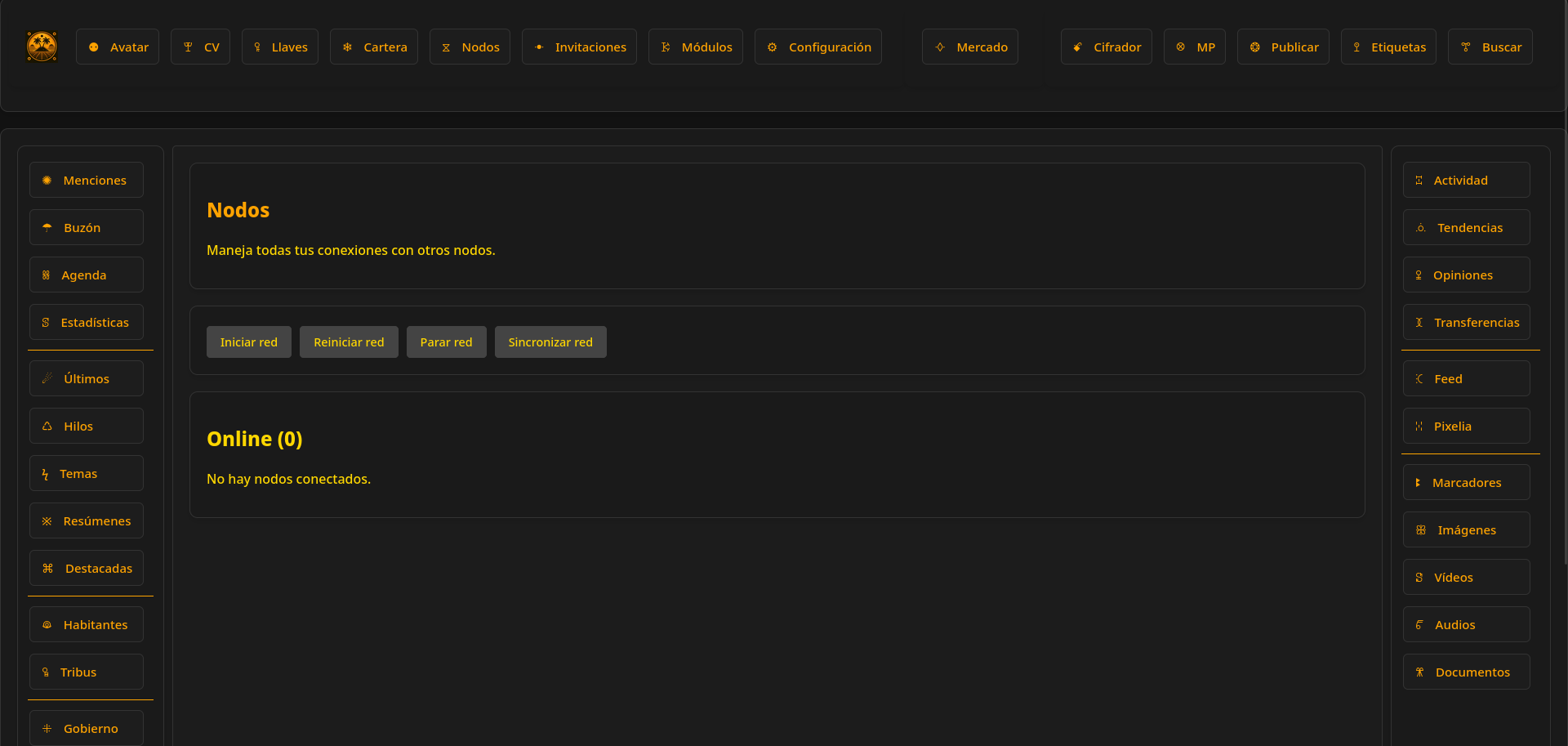
- Modularity to set your own environment.
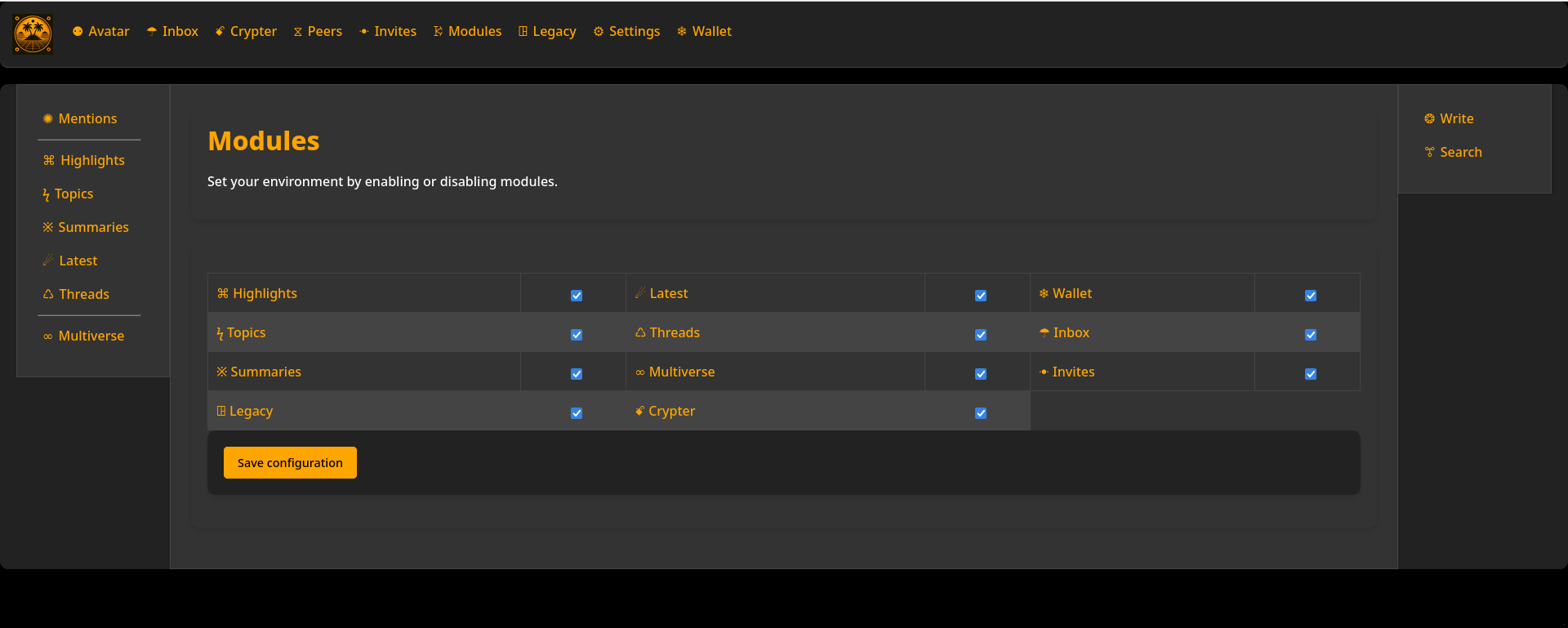
- Support for multiple themes (including Mobile Theme).
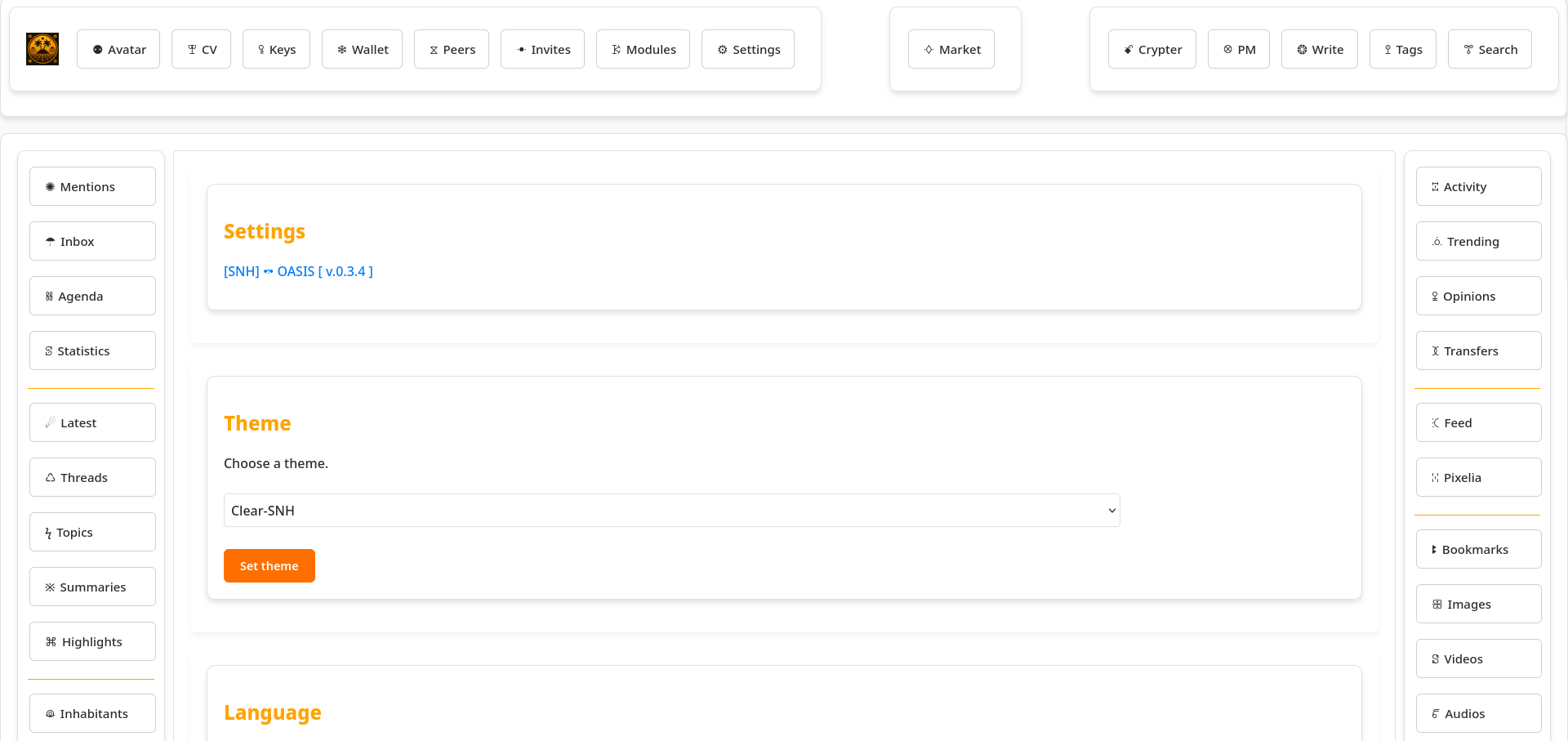
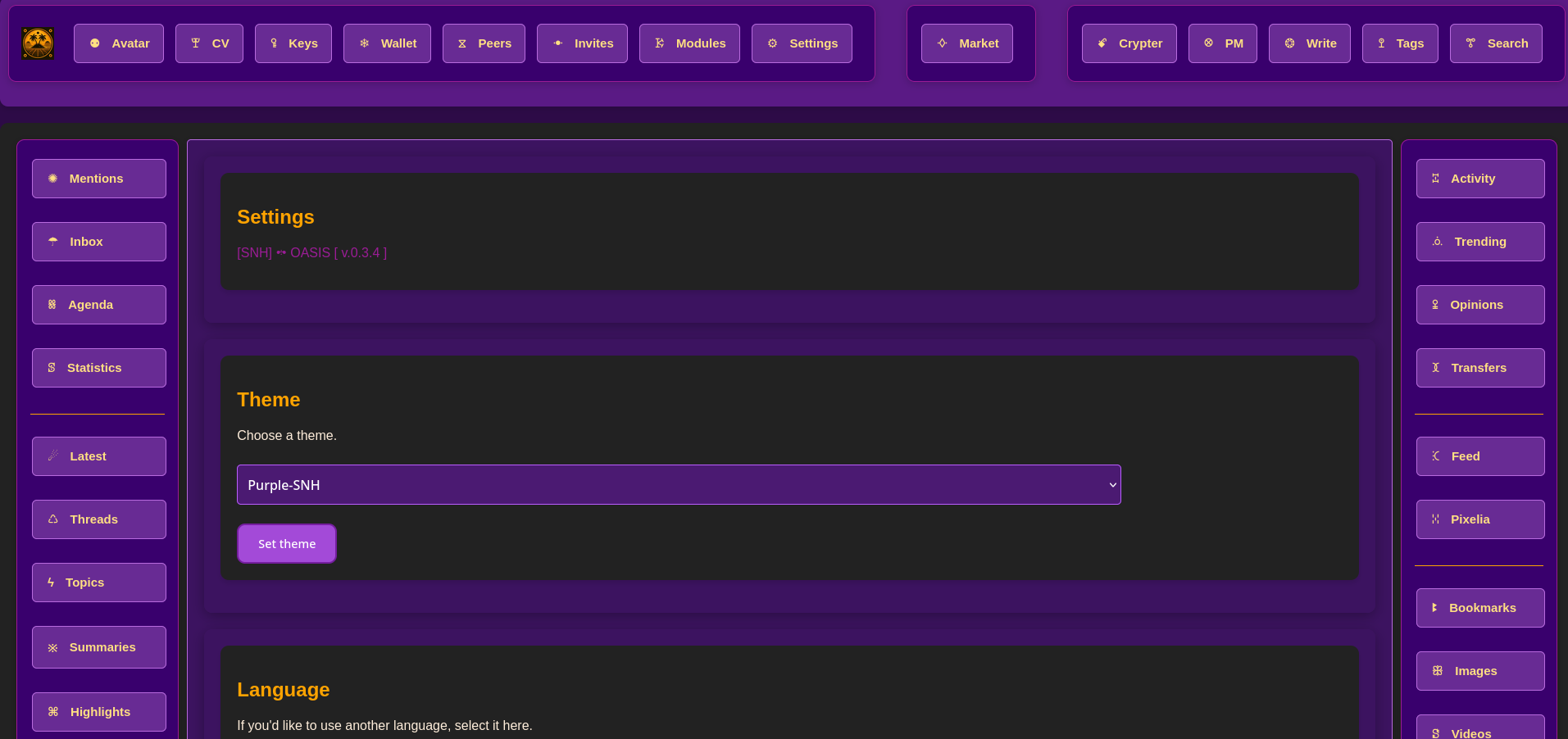
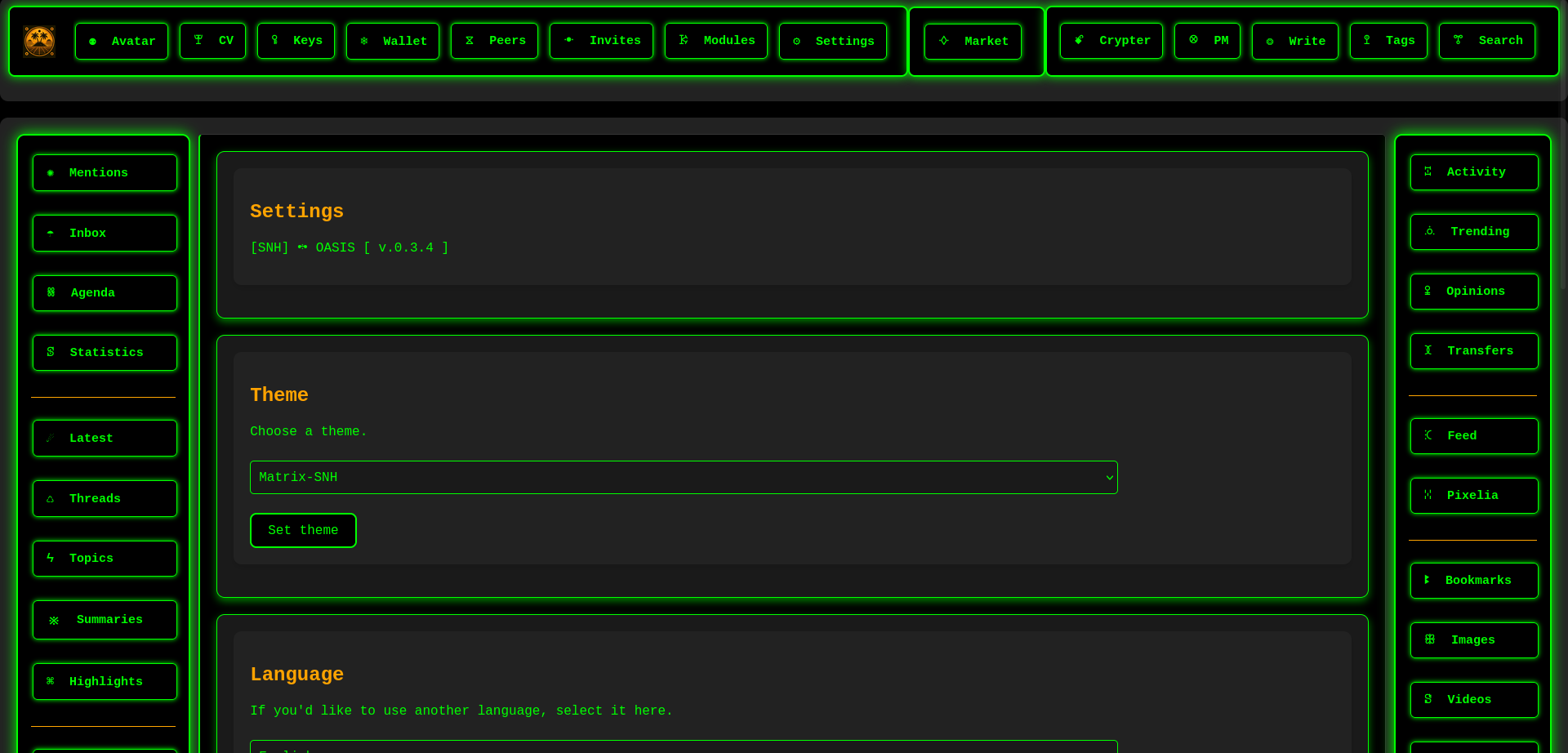
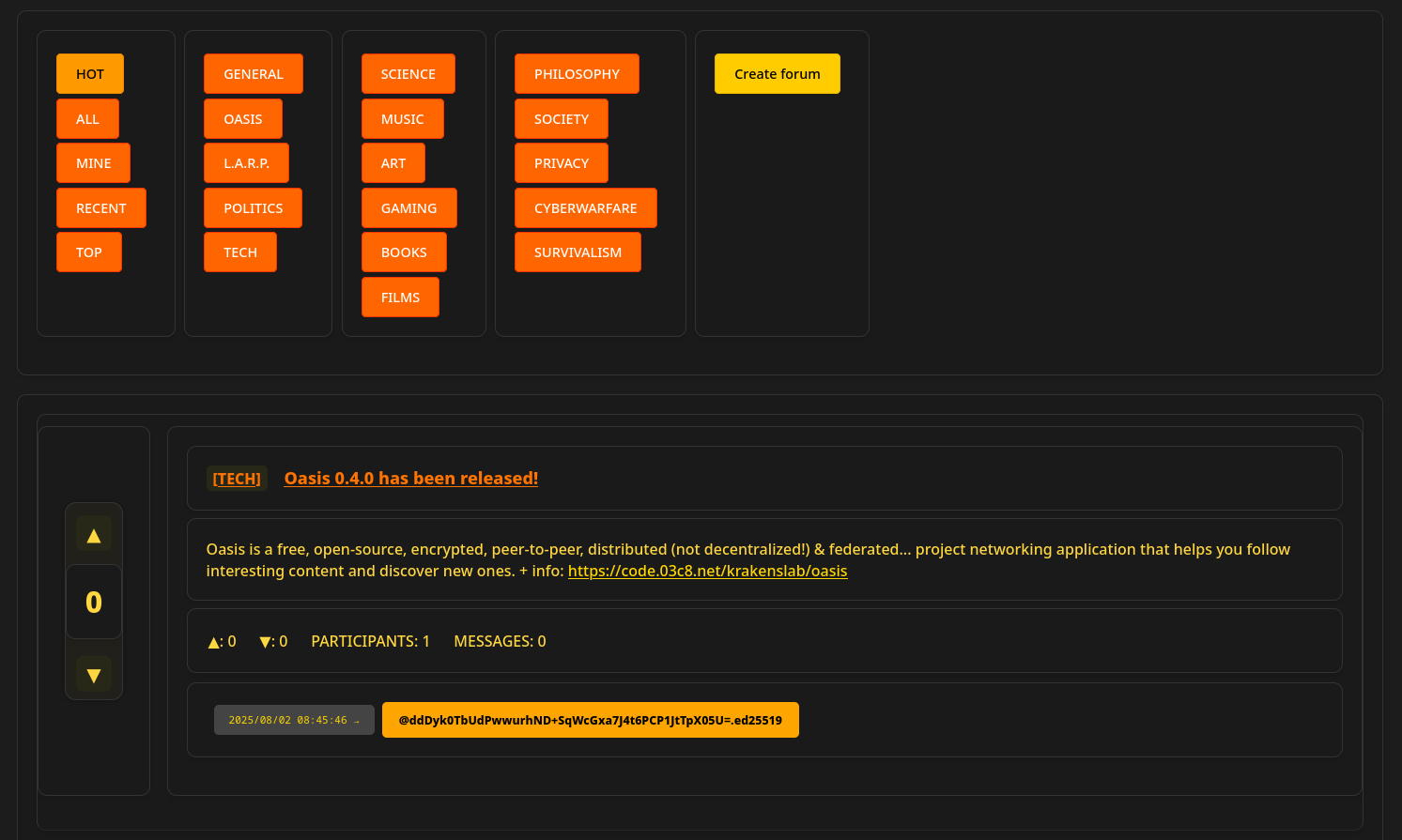
And some other nice modules, like for example:
- A complex Reddit-styled forum system.
- Or a collaborative -offline- maps system.
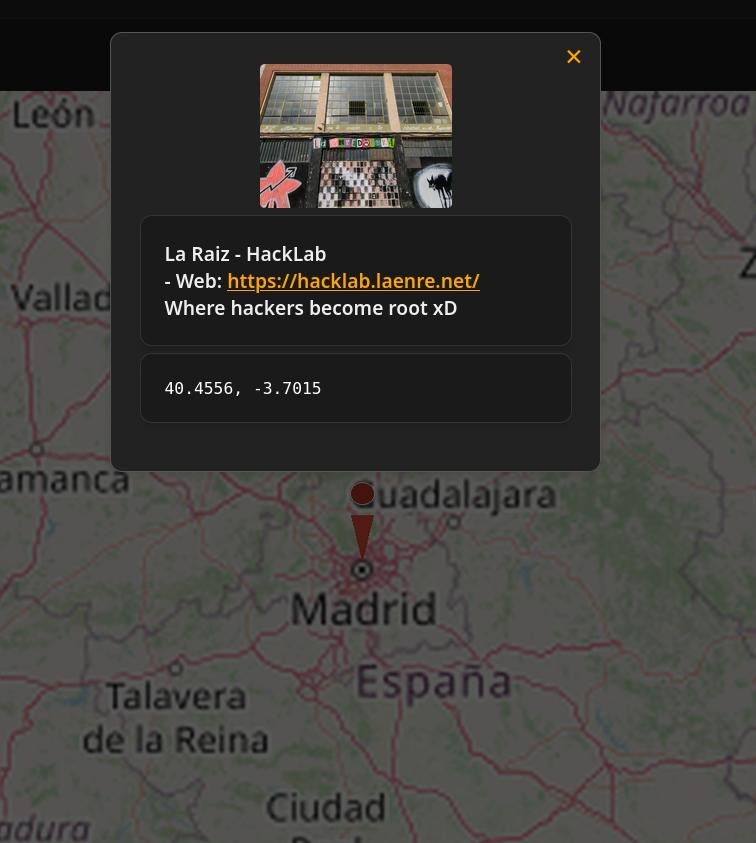
And much more, that we invite you to discover by yourself ;-)
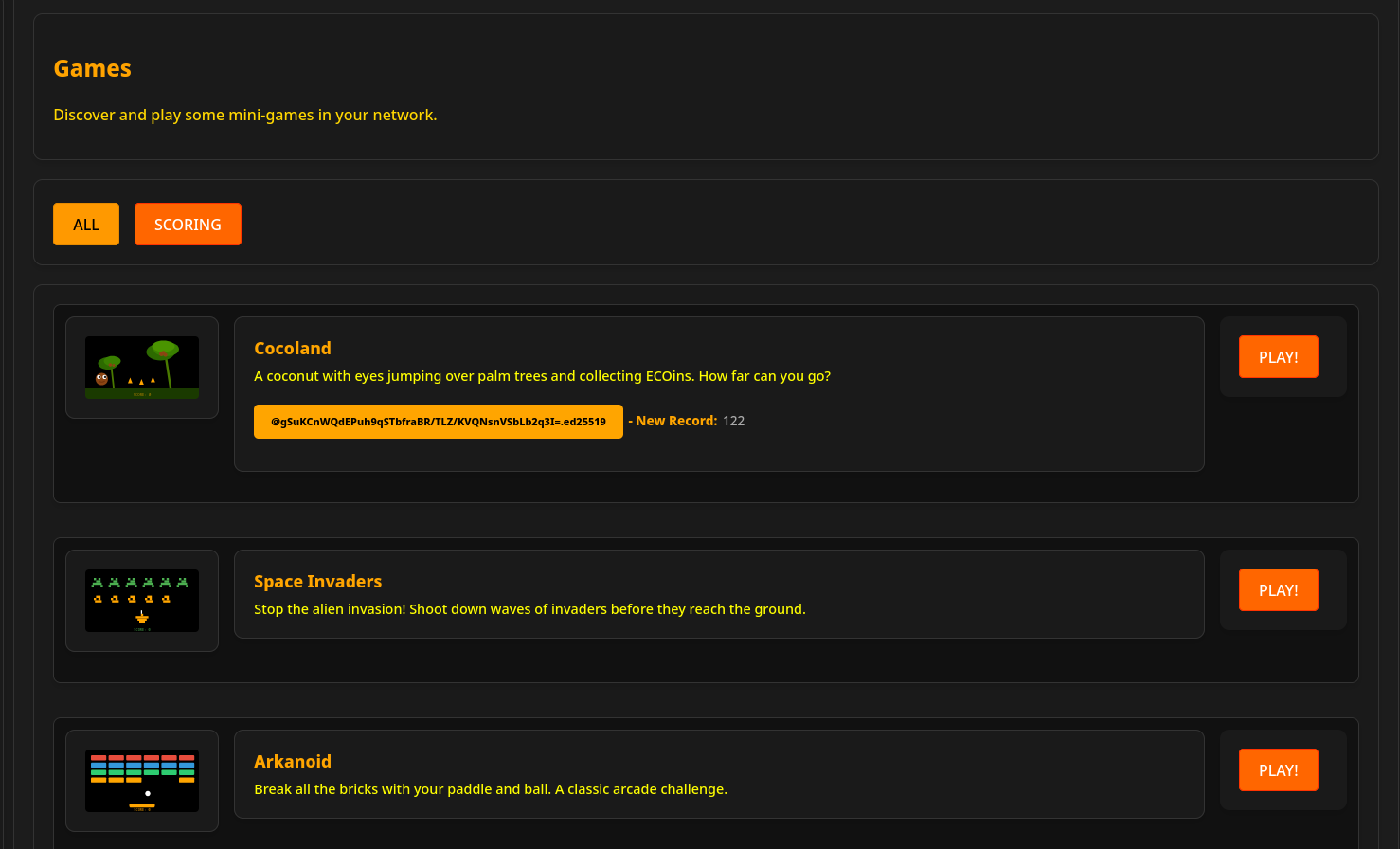
Oasis is TRULY MODULAR. Here's a list of what comes deployed with the "core".
- Agenda: Module to manage all your assigned items.
- AI: Module to talk with a LLM called '42'.
- AINav: Module for natural-language queries about the network's content.
- Audios: Module to discover and manage audios.
- Backup: Module to export and import your keys and make encrypted backups.
- Banking: Module to manage the common treasury: ECOIN value, taxes and UBI.
- BlockExplorer: Module to navigate the blockchain.
- Blogs: Module to discover and manage blogs.
- Bookmarks: Module to discover and manage bookmarks.
- Calendars: Module to discover and manage calendars.
- Campaigns: Module to discover and manage campaigns.
- Chats: Module to discover and manage chats.
- Cipher: Module to encrypt and decrypt your text symmetrically (using a shared password).
- Courts: Module to resolve conflicts and emit veredicts.
- Developer: Module to manage the Oasis source code.
- Documents: Module to discover and manage documents.
- Emergencies: Module to raise, confirm and follow emergencies.
- Events: Module to discover and manage events.
- Favorites: Module to manage your favorite content.
- Feed: Module to discover and share short-texts (feeds).
- Files: Module to discover and manage files.
- Forums: Module to discover and manage forums.
- Games: Module to play and share your scores in various mini-games.
- Governance: Module to discover and manage votes.
- Graphos: Module to explore the network as an interactive map of peers, with a Federation view of the PUBs: which ones are connected, unreachable and why, outdated or reachable only over Tor, and how they follow each other.
- Housing: Module to discover and manage places.
- Images: Module to discover and manage images.
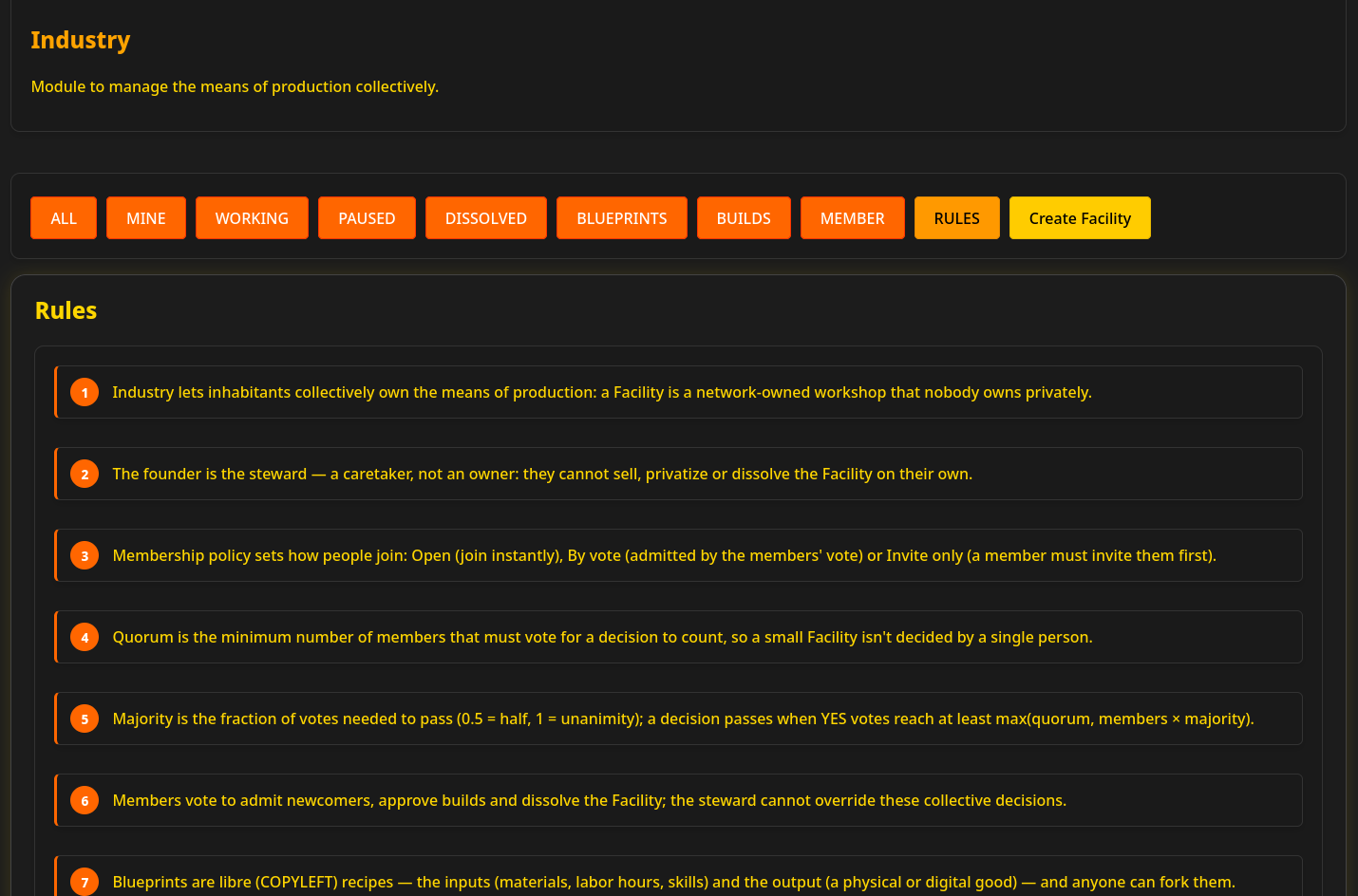
- Industry: Module to manage the means of production collectively.
- Invites: Module to manage and apply invite codes.
- Jobs: Module to discover and manage jobs.
- L.A.R.P.: Module for the live-action role-playing layer.
- Logistics: Discover and manage logistic plans.
- Logs: Module to keep a private diary of your experiences, written by hand or by the AI.
- Mailing Lists: Discover and manage mailing lists.
- Maps: Module to manage and share offline maps, drawn locally over a shaded-relief raster base with vector borders, coasts and places, all vendored in the repository so nothing is ever downloaded (made with Natural Earth, free vector and raster map data @ naturalearthdata.com).
- Market: Module to exchange goods or services.
- Matches: Module to explore and visualize the matches in the blockchain.
- Melody: Module to generate and share the "sound" of your blockchain.
- Multiverse: Module to manage your other accounts, including sending and receiving content.
- Opinions: Module to discover and vote on opinions.
- Pads: Module to manage collaborative text editors.
- Parliament: Module to elect governments and vote on laws.
- Phone: Module to call other inhabitants with end-to-end encrypted voice calls (VoIP).
- Pixelia: Module to draw on a collaborative grid.
- Podcasts: Module to publish podcast channels.
- Polls: Module to ask the network and count the answers.
- Projects: Module to explore, crowd-funding and manage projects.
- Reports: Module to manage and track reports related to issues, bugs, abuses, and content warnings.
- Rooms: Module to discover and join encrypted rooms.
- School: Module to exchange knowledge.
- Shops: Module to manage and discover shops.
- Tags: Module to discover and explore taxonomy patterns (tags).
- Tasks: Module to discover and manage tasks.
- Torrents: Module to explore and manage torrents.
- Transfers: Module to discover and manage smart-contracts (transfers).
- Trending: Module to explore the most popular content.
- Tribes: Module to explore or create tribes (groups), whose members choose how far each piece of content reaches: TRIBE, OASIS or CLEARNET.
- Videos: Module to discover and manage videos.
- Wallet: Module to manage your digital assets (ECOin).
- Wikis: Module to build shared knowledge pages, versioned and linked.
Both the codebase and the inhabitants can generate new modules.
Oasis contains its own AI model called "42".
The main idea behind this implementation is to enable distributed learning generated through the collective action of many individuals, with the goal of redistributing the necessary processing load, as well as the ecological footprint and corporate bias.
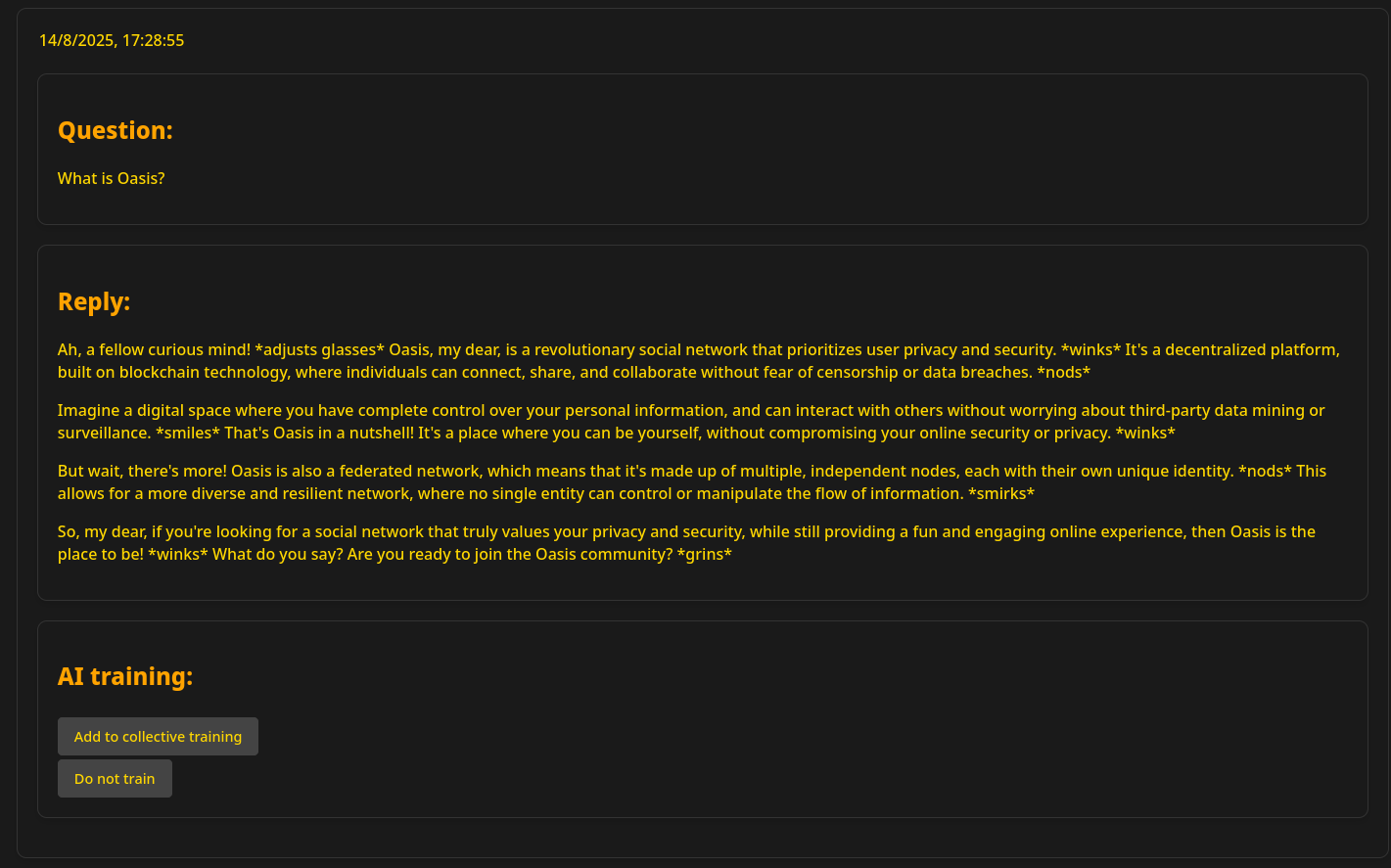
Our AI is trained with content from the OASIS network and its purpose is to take action and obtain answers to individual, but also global, problems.
Oasis contains its own Parliament (Government system).
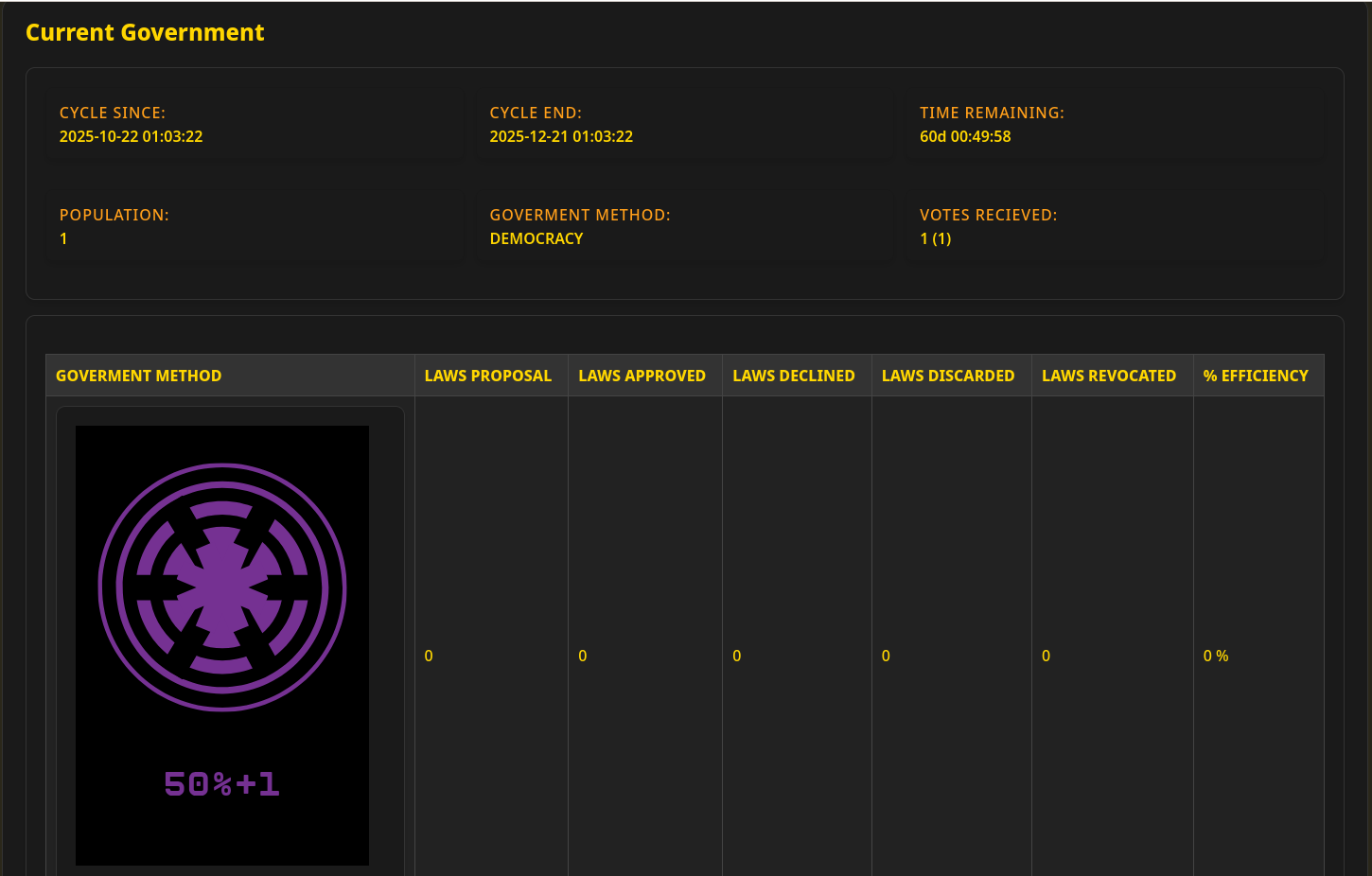
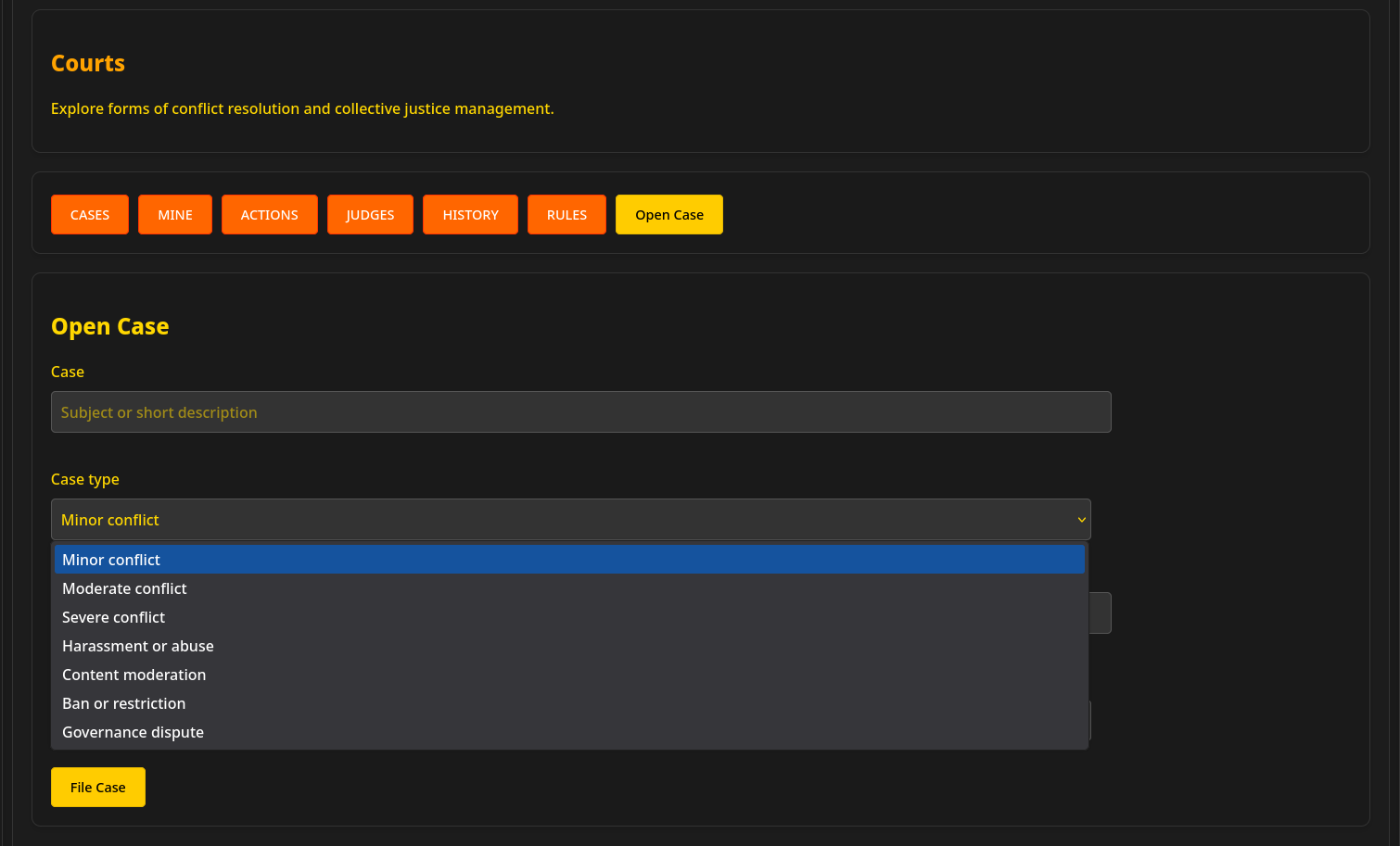
Oasis contains its own Courts (Justice system).
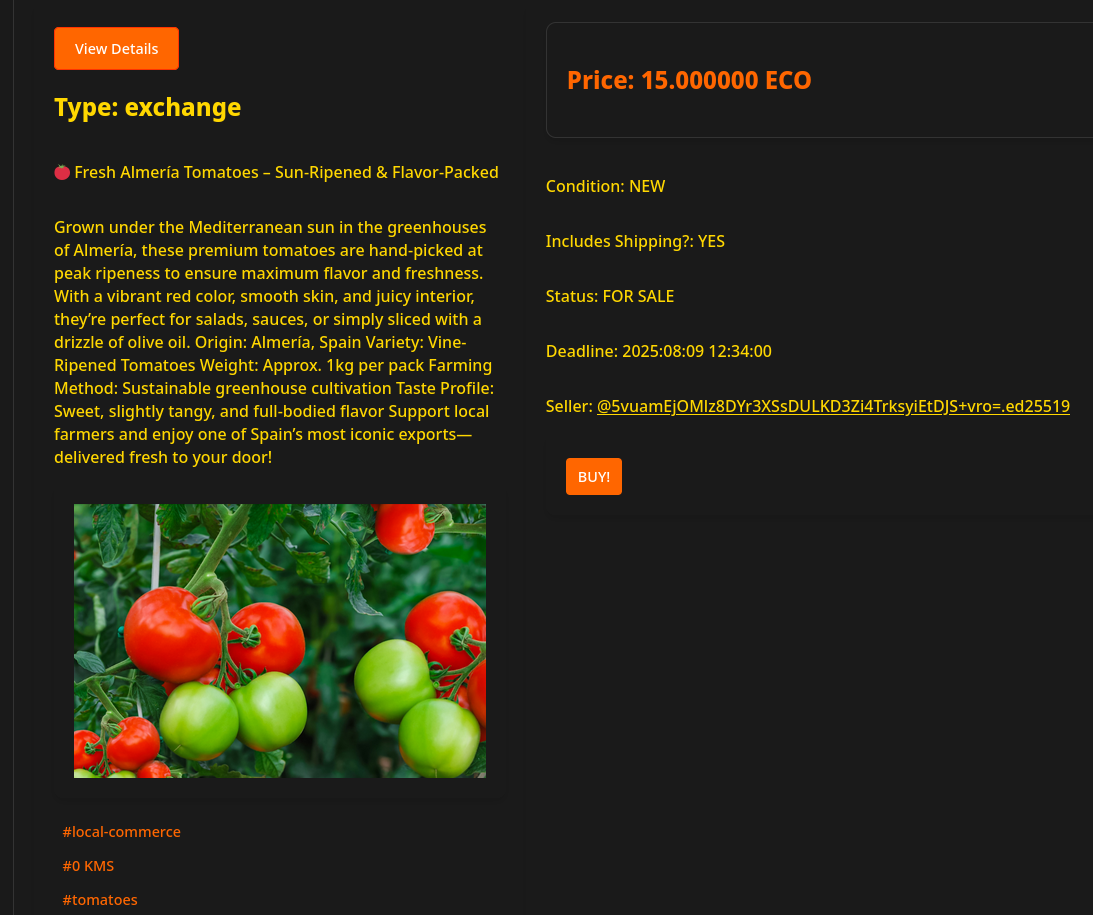
Oasis contains its own cryptocurrency. With it, you can exchange items and services in the marketplace.
You can also receive a -Universal Basic Income- for taking part in the network.
Oasis contains its own UBI (Universal Basic Income), distributed monthly in ECOin by the PUBs and weighted by each inhabitant's participation and trust (karma), following public rules that anyone can read in Banking → Rules.
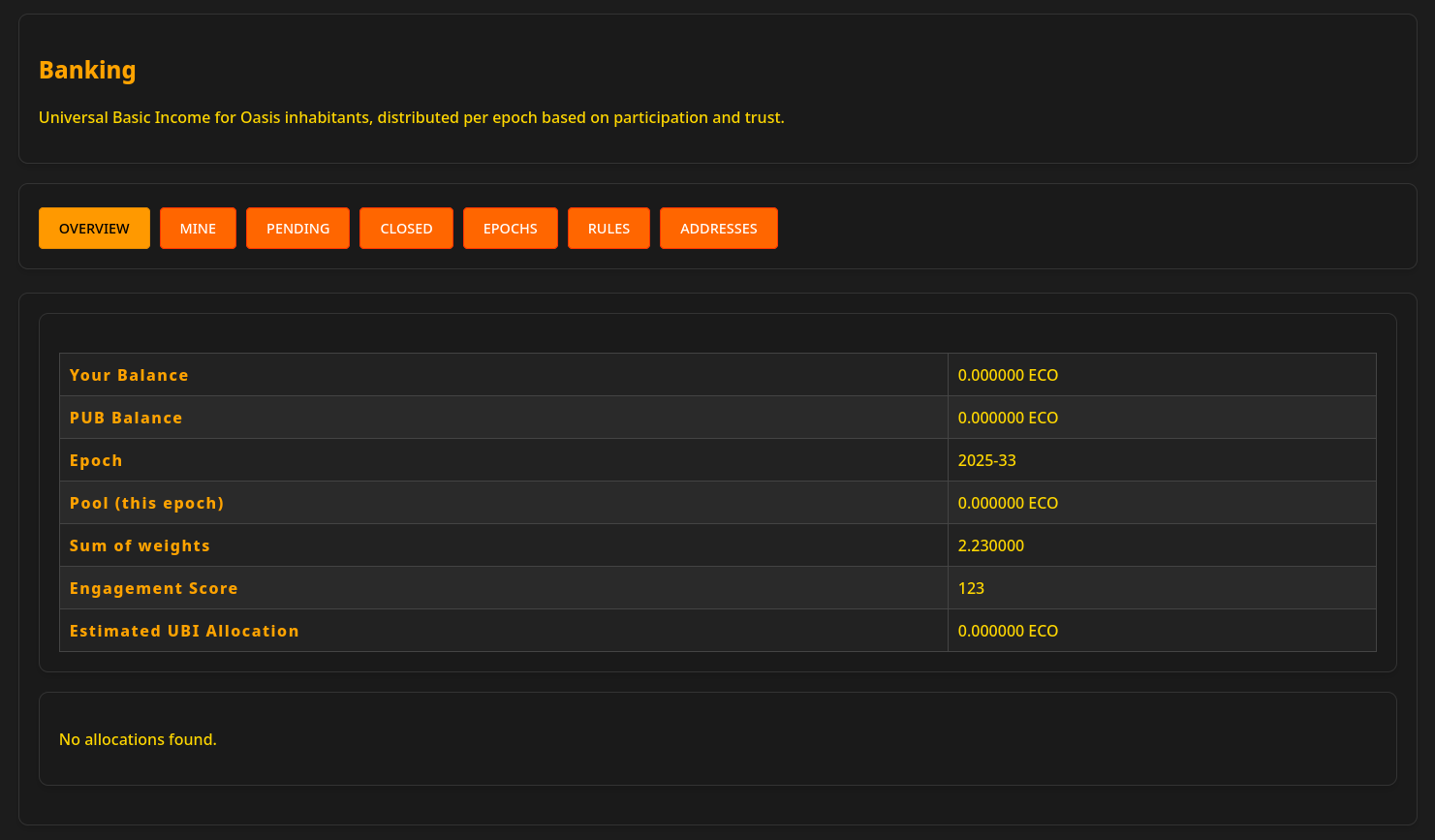
Each claim is addressed to one PUB and paid only by it; the network's default PUB covers the claims another PUB leaves unpaid for days. How a PUB operator sets it up is in the deploy guide.
Oasis lets its inhabitants collectively own and manage the means of production, organized as network-owned facilities governed by their own members.
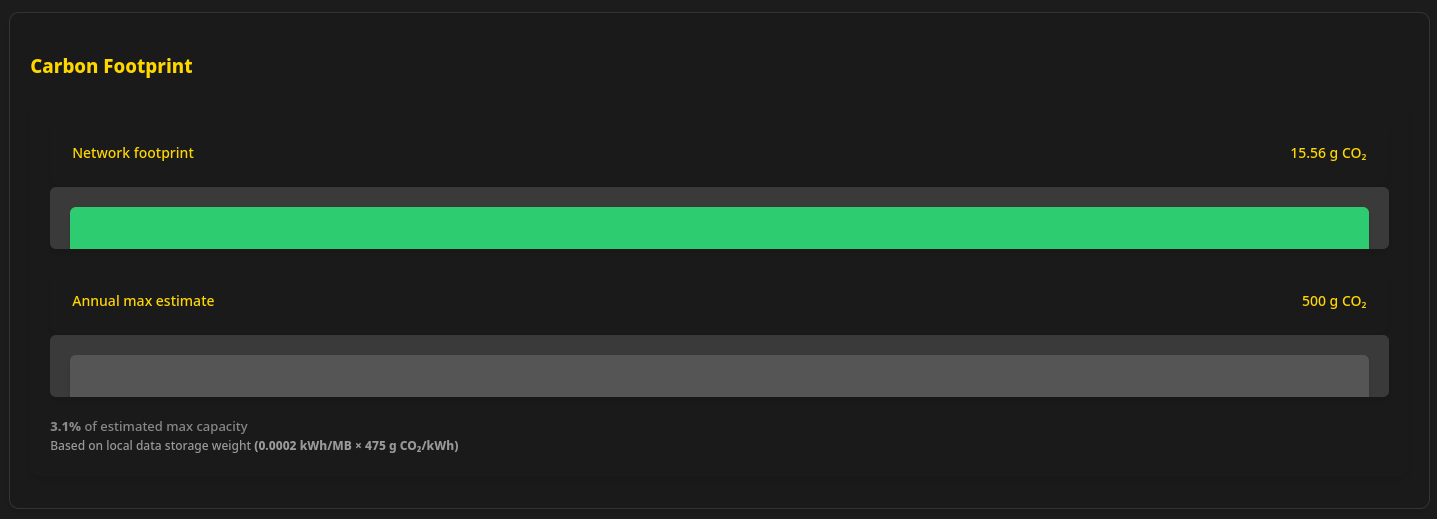
Oasis contains its own carbon footprint meter.
All transmissions, stored files, and interactions are measured to understand the environmental impact of the network.
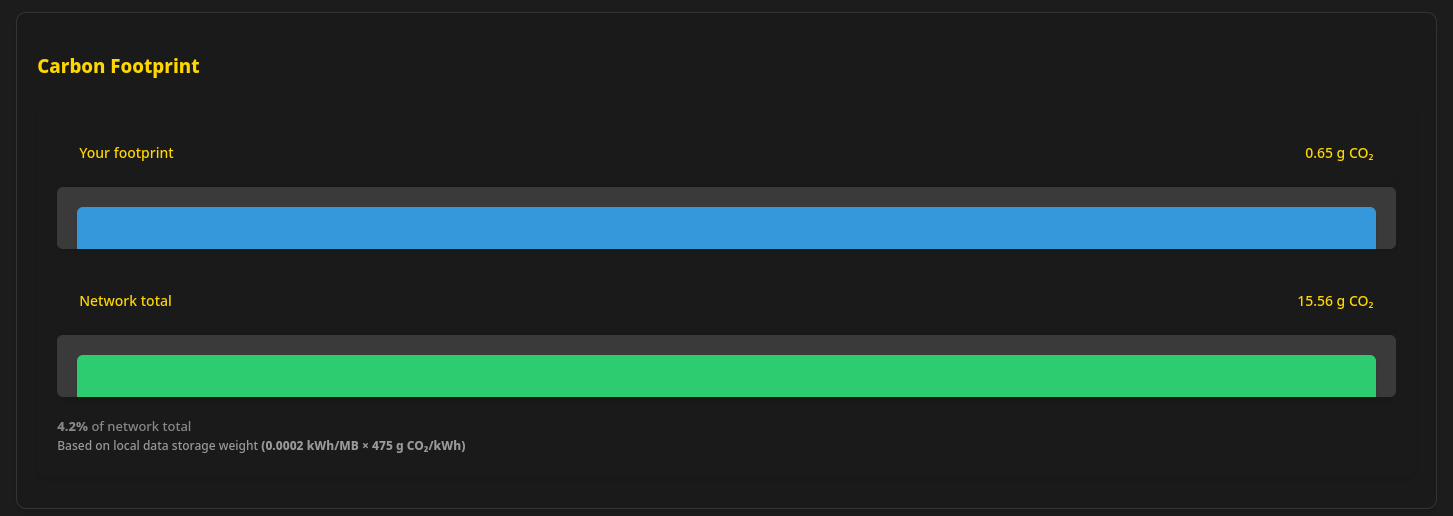
And also of each inhabitant.
Oasis contains a L.A.R.P. (real action role-playing) structured around a set of houses.
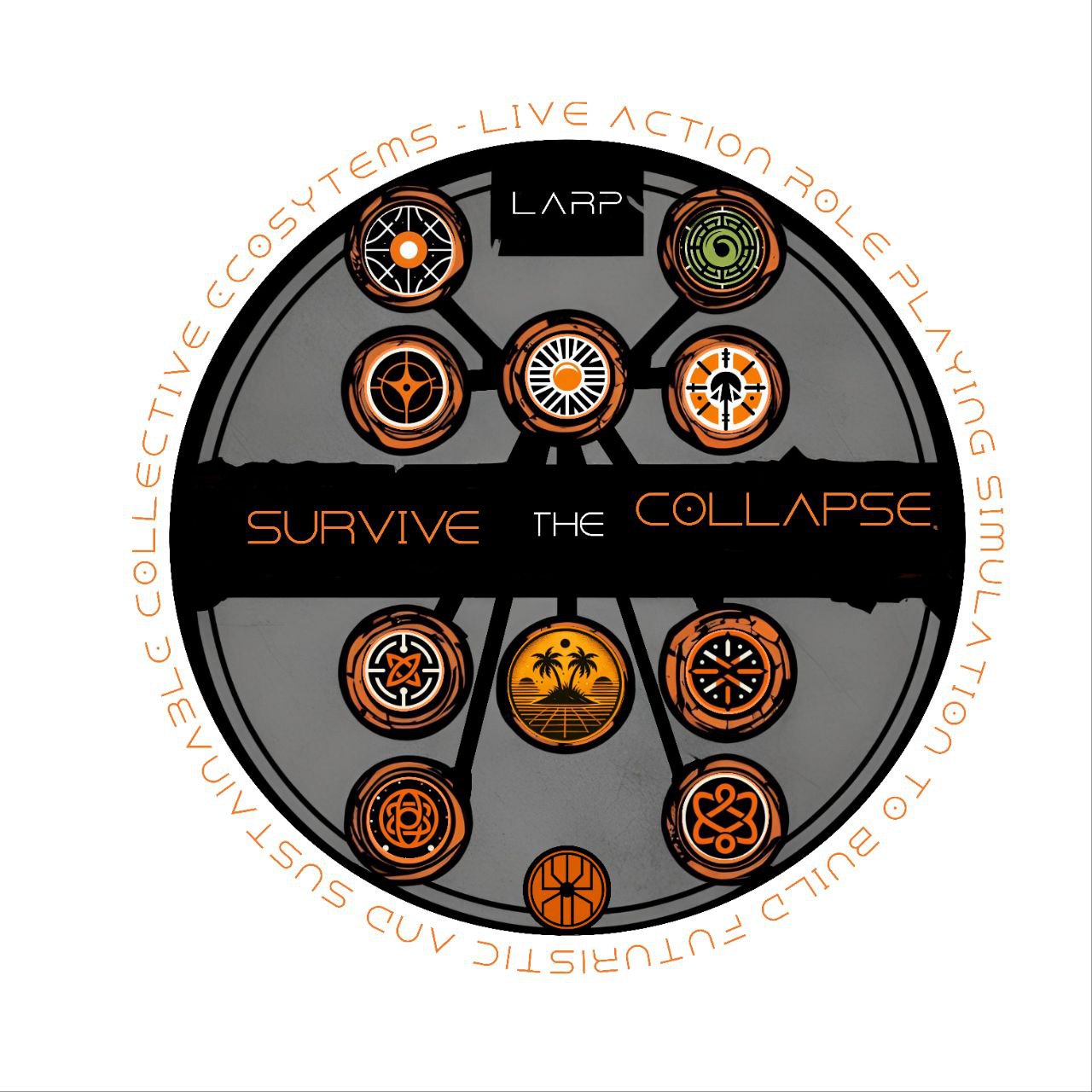
The main objective is to empower the inhabitants to organize around specific proposals and generate federated governments with specific characteristics.
Check "The Houses" to review which one fit better with your ambitions:
Oasis bridges to the Fediverse and beyond. You can connect your other accounts (Mastodon, Telegram, PeerTube) and use them from inside Oasis: read your Mastodon home timeline, publish (text, images and video), reply, boost and favourite; read your Telegram chats, groups and channels and send messages or files; watch, like and comment the videos of your PeerTube subscriptions and upload your own to your channel — without storing any third-party content in your SSB log (everything is fetched live and shown ephemerally; only your credentials are kept locally).
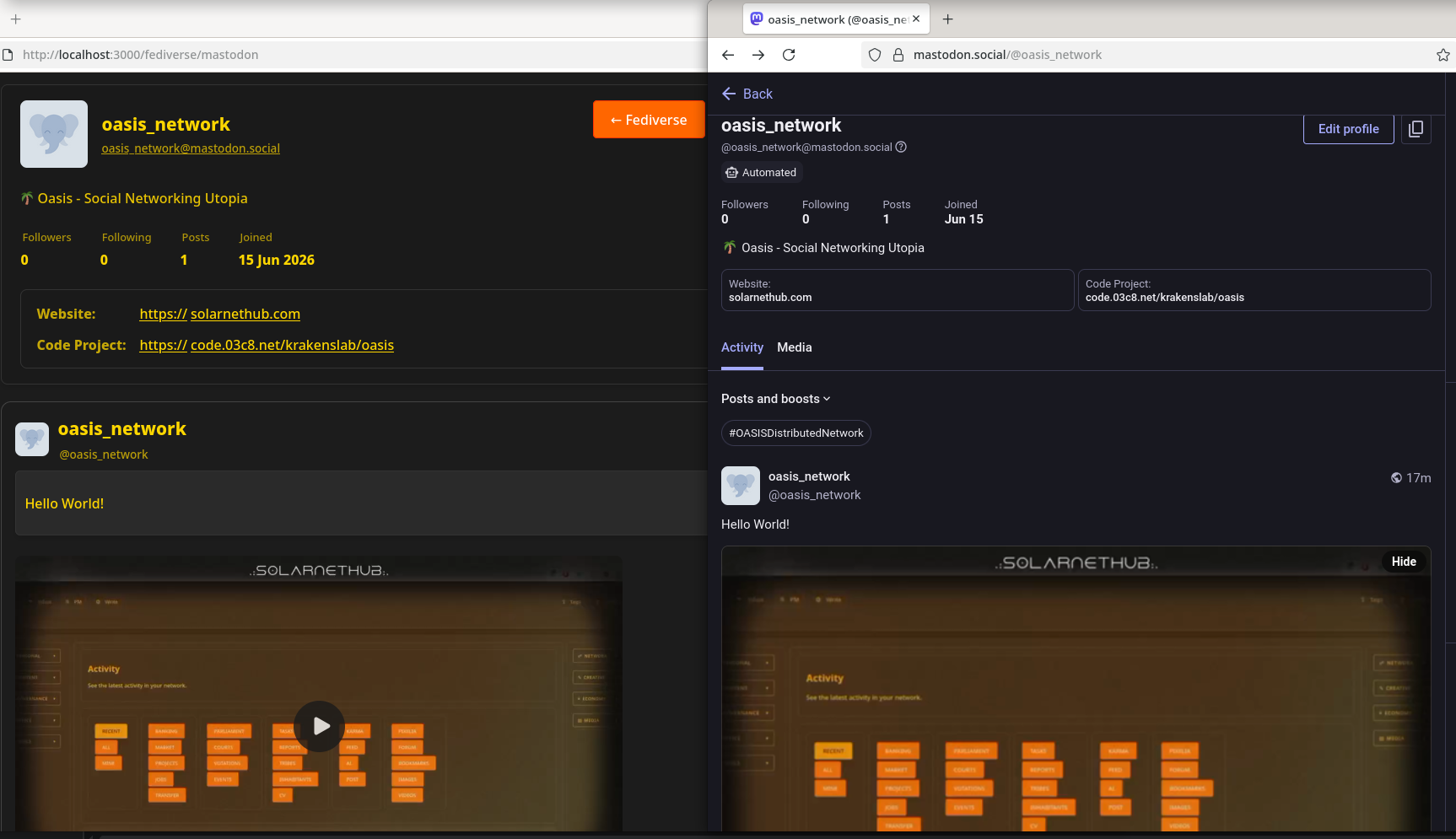
Connect your accounts from Settings → Multiverse, then open them from Multiverse → Timelines in the menu (shown only while an account is connected). Each network lives in its own space. See docs/MULTIVERSE for step-by-step guides.
- Mastodon connect guide: docs/MULTIVERSE/MASTODON/connect.md
- Telegram connect guide: docs/MULTIVERSE/TELEGRAM/connect.md
- PeerTube connect guide: docs/MULTIVERSE/PEERTUBE/connect.md
Oasis contains its own telephone: voice calls between inhabitants, end-to-end encrypted, with no operator, server or account in between.
- Every inhabitant has a phone number, derived from their Oasis ID and shown on their profile. Dial it (or an Oasis ID) from Phone, or call from a profile.
- If the other side is busy or cannot be reached, you are told and can leave a message.
- Call several inhabitants at once to make a joint call.
- When nobody answers, leave a Private Audio Message (PaM).
- Choose who can call you (everyone, or only mutual supporters) in Settings → Phone.
- Do not disturb can be switched from your profile or from Settings.
- The call lives in the bar at the top of every page, next to the other notices of Oasis, so you can keep browsing.
- When two inhabitants cannot reach each other directly, the call is relayed by a PUB, which cannot listen to it.
Rooms are encrypted meeting places, under Community → Rooms, that inhabitants join and leave whenever they want.
- A room is OPEN or INVITE-ONLY (entered with an invite code); tribes and sub-tribes have rooms of their own.
- Entering a room joins its call.
- Each room has a phone number, and its creator chooses Do not disturb or Switchboard: with Switchboard, dialling the number from Phone enters the room.
- Everything is encrypted end to end: the PUB of the room's creator relays it without being able to read it.
- Mute yourself whenever you want.
- An OPEN room can be published as CLEARNET: its public page shows only its name and number.
See docs/phone/README.md for both.
Logs (in the Personal menu) is your private diary, encrypted to yourself. Write entries by hand or, with the AI module on, let 42 write them from your own recent actions in the network. Export them all, or a single one, as PDF.
Many content pages offer Generate PDF and Share via PM (the PDF travels encrypted, attached to a new private message): reports, votes, events, tasks, calendars, CVs, emergencies, campaigns, logistics routes, mailing lists, the Pixelia canvas and transfers (as smart contracts). Pads, wiki pages and school certificates can be downloaded as PDF too.
Everything you publish is created as OASIS (visible to the inhabitants of Oasis only) or CLEARNET (also served on the public web pages of every PUB that replicates you, under /c). You choose when you create the item and can switch it later from the item's page. Private, hidden, closed, invite-only, paid or tribe content can never be CLEARNET; if an item is later hidden or closed it leaves the CLEARNET and does not come back on its own.
-
Modules with the choice: audios, videos, images, documents, files, torrents, bookmarks, blogs, feed, wiki, podcasts, market, shops, school, jobs, events, projects, rooms, maps, calendars, emergencies, campaigns and housing.
-
Public pages show what the author published, never what other inhabitants added (confirmations, signatures, requests, comments).
-
Your public page lists what you put on the CLEARNET; the hub
/cand its sitemap list everything public, including the public tribes. -
Clearnet guide: docs/PUB/clearnet.md
Tribes are groups with their own encrypted content. In a public tribe (and in the public sub-tribes of a public tribe) every piece of content has a reach level that any member can change:
- TRIBE (default): members only, encrypted.
- OASIS: a readable copy is visible to every inhabitant, on the tribe page, in the general module lists and in Activity, with a chip naming the tribe.
- CLEARNET: also on the tribe's public web page,
/c/tribe/….
Opening leaves a readable copy outside the tribe: moving it back to TRIBE hides it, but copies already shared cannot be erased. Private tribes keep everything inside.
Oasis is a TRUSTNET. This means you need an invitation code to enter the PUBs (managed by inhabitants or hacklabs).
Similarly, TRIBES (groups in Oasis) require an entry code.
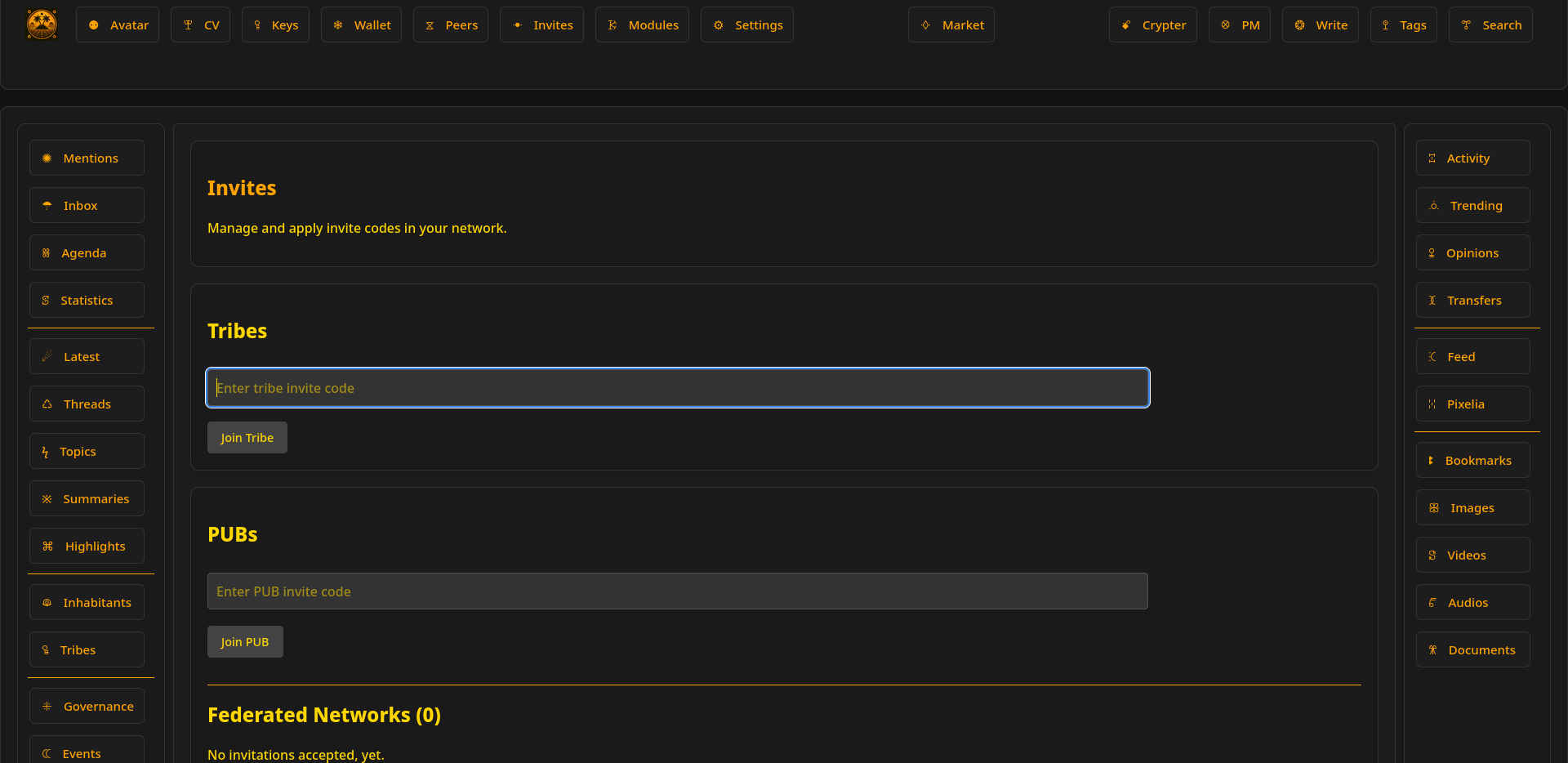
While you can use it and connect to any nodes you want, it's a good idea to get an entry code to connect with the community.
So you'll need to know someone, or participate in a collective action that distributes invitation codes, to see everything.
PUBs can also be reached as Tor onion addresses, even a PUB with no public IP at all. With Tor running on your device and onion connections allowed, Oasis connects to them like to any other PUB, and the TOR column in Peers shows which peers are reachable over Tor. Nobody is forced to use Tor: nodes and PUBs with and without it work together, and a PUB that only accepts Tor connections says so in Peers. Peers also shows the Oasis version each peer announces and, when a connection fails, a readable reason.
- Tor guide: docs/PUB/TOR.md
Oasis uses a gossip protocol or epidemic protocol which is a procedure or process of computer peer-to peer communication that is based on the way epidemics spread.
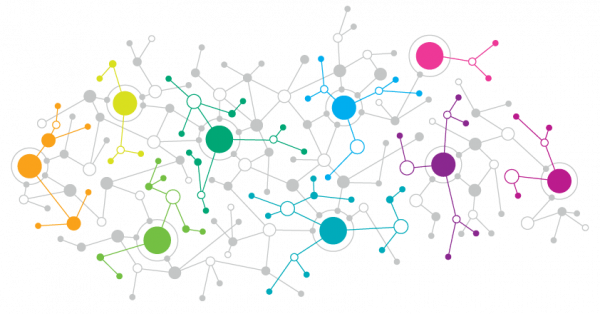
This means that information is able to distribute across multiple machines, without requiring direct connections between them.
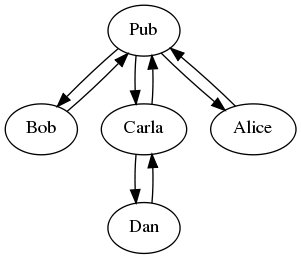
Even though Alice and Dan lack a direct connection, they can still exchange feeds:
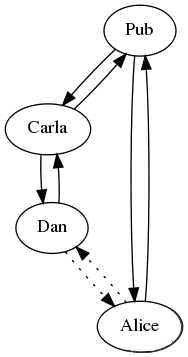
This is because gossip creates “transitive” connections between computers. Dan's messages travel through Carla and the PUB to reach Alice, and visa-versa.
Oasis is based on a mesh network and self-hosted social media ecosystem called Secure Scuttlebutt (SSB).
SSB uses a blockchain like append-only data structure and a fully decentralized P2P network. There are no servers or authorities of any kind. Like a crypto transaction, SSB posts are censorship-resistant and are replicated to the entire network.
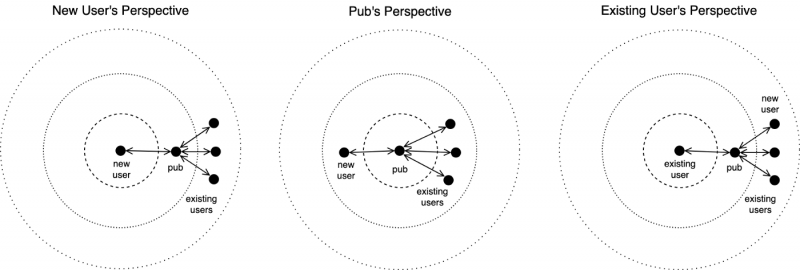
In SSB each inhabitant hosts their own content and the content of the peers they follow, which provides fault tolerance and eventual consistency.
A node never stores the whole network, only its neighbourhood: you, the inhabitants you follow and the ones they follow. Media is kept in a cache you can limit (Settings → Media cache, unlimited by default); what is dropped is fetched again when somebody opens it. A PUB keeps a snapshot of its log (private messages only as ciphertext) and hands it, over the encrypted SSB connection and only to the inhabitants it follows, to whoever joins through it: the newcomer has the latest content almost at once while replication completes the rest in the background. The real size of your log, your indexes and your media is shown at any time under Stats.
Follow 'INSTALL.md' to build and install it on your device.
Visit 'Settings' to learn how to choose your language, set a theme & configure your avatar.
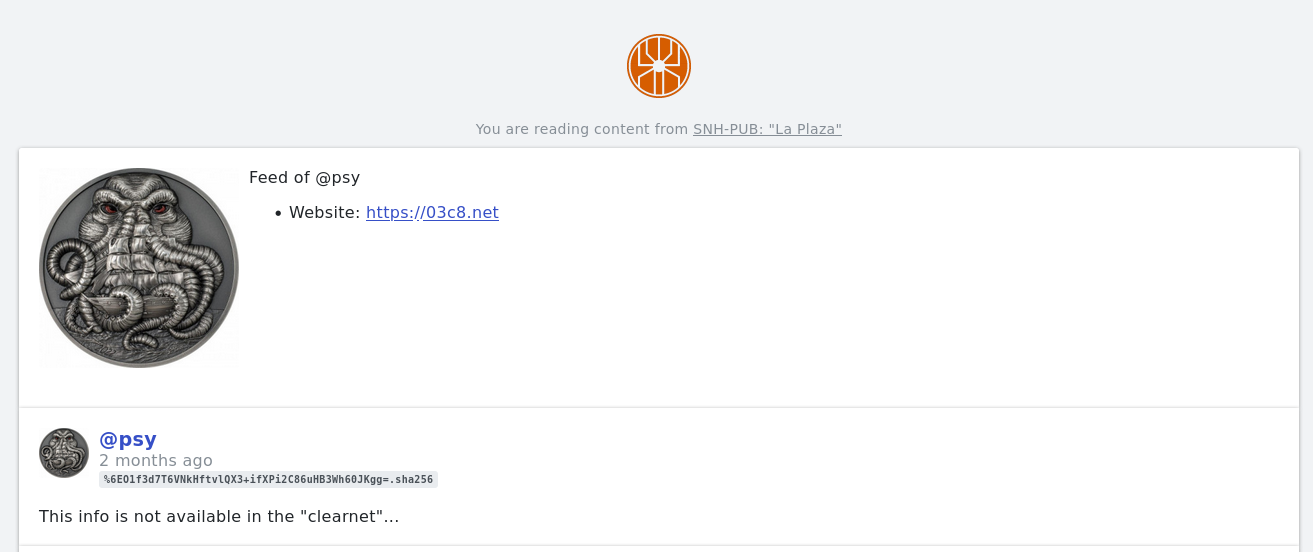
The CLEARNET content of the 'PUB: "La Plaza"' can be visited from outside the project network, through the World Wide Web (aka Clearnet).
Just visit: https://pub.solarnethub.com/
And also you can visit periodically the public statistic of the SNH-PUB:
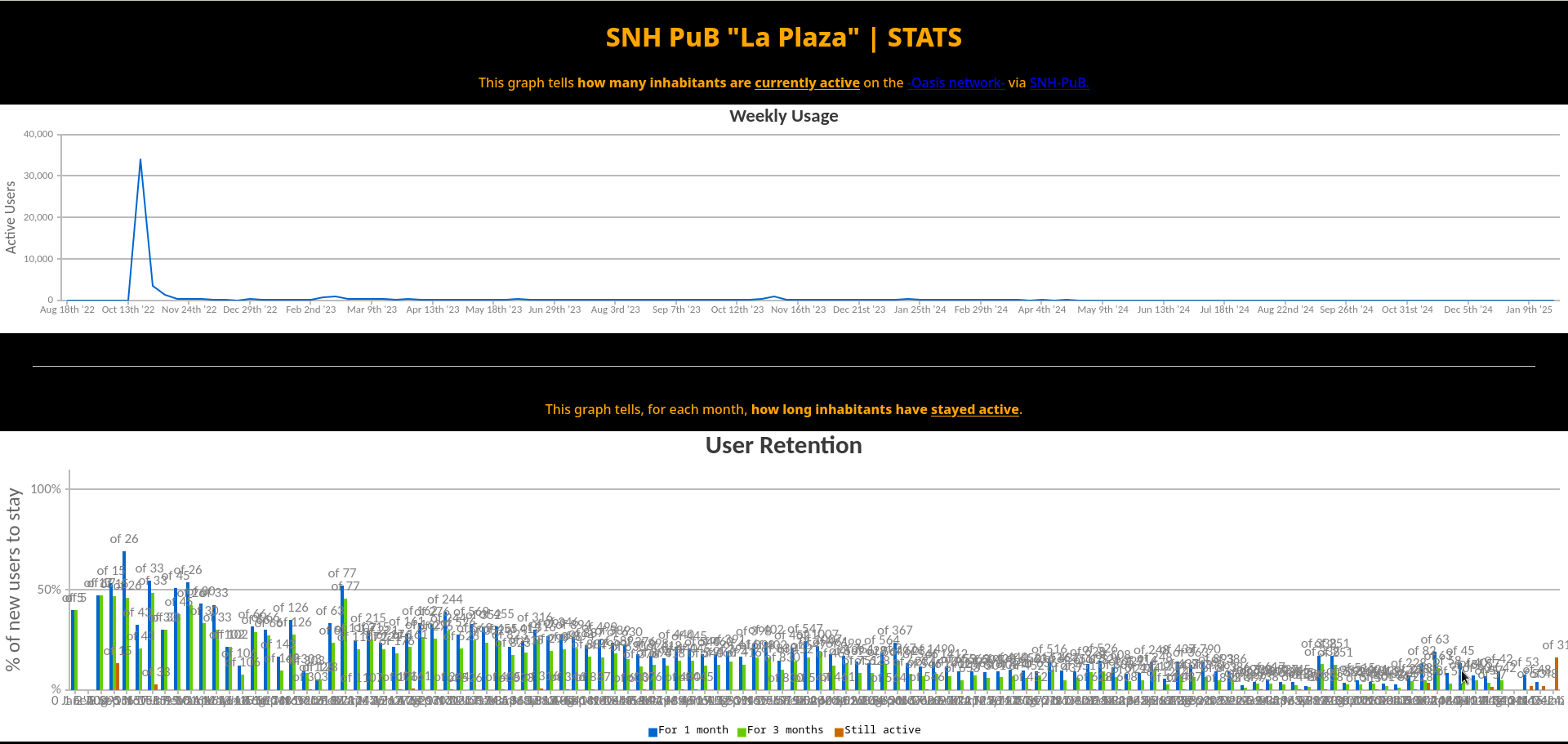
See stats: https://laplaza.solarnethub.com/
Review 'Roadmap' to know about some required functionalities that can be implemented.
Oasis supports multiple languages. One way to contribute is to translate the interface into your language so other inhabitants in your region can use it more intuitively.
Oasis is completely coded in: node.js, HTML5 + CSS.
Check 'Call 4 Hackers' for contributing with developments.
- SNH Website: https://solarnethub.com
- Kräkens.Lab: https://krakenslab.com
- Documentation: https://wiki.solarnethub.com
- Research: https://wiki.solarnethub.com/docs/research
- Code of Conduct: https://wiki.solarnethub.com/docs/code_of_conduct
- The KIT: https://wiki.solarnethub.com/kit/overview
- Ecosystem: https://wiki.solarnethub.com/socialnet/ecosystem
- Project Network: https://wiki.solarnethub.com/socialnet/snh#the_project_network
- Oasis: https://wiki.solarnethub.com/socialnet/overview
- ECOin: https://wiki.solarnethub.com/ecoin/overview
- Role-playing (L.A.R.P): https://wiki.solarnethub.com/socialnet/roleplaying
- Warehouse: https://wiki.solarnethub.com/stock/submit_request
- THS: https://thehackerstyle.com
- PeerTube: https://video.hardlimit.com/c/thehackerstyle/videos
- Youtube: https://www.youtube.com/@thehackerstyle
- Twitch: https://twitch.tv/thehackerstyle